
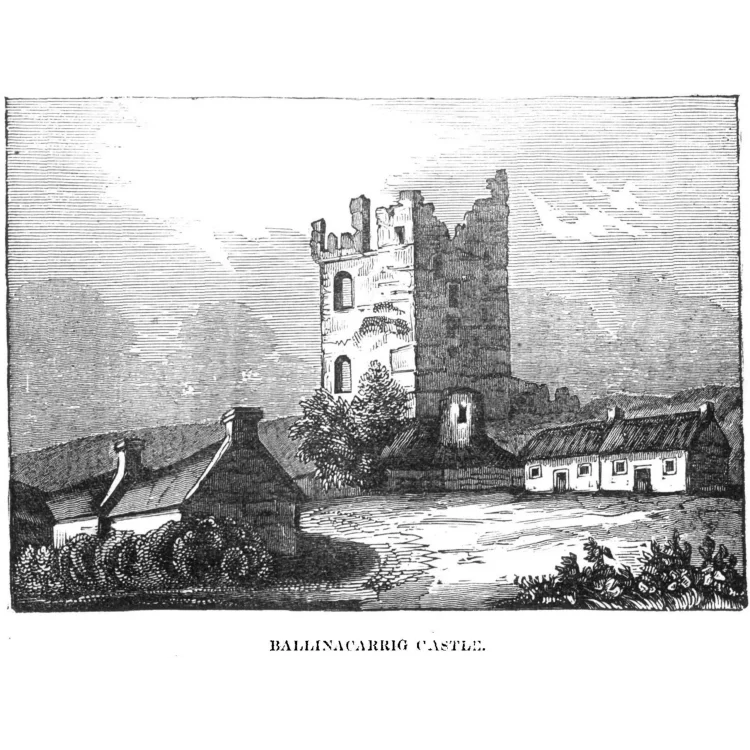
Ballinacarriga Castle is a 16th-century, four storey Irish tower house overlooking a lake, less than 10kms from Dunmanway. To explore the tower house continue from here to the townland of Manch, turn right at the crossroads and the castle is a short distance along the road. It proudly stands as a sophisticated example of a native Irish castle in the area. Its Irish name, Béal na Carraige, means “Mouth of the Rock,” which reflects its local landscape and strong medieval character. The castle is a national monument in state guardianship.
Though linked to the Hurley, family, some suggest it may originally have been an older McCarthy stronghold with the Hurleys acquiring it through marriage, alliance, or conflict. The date 1585 carved into the stonework is often taken as evidence of building or major renovation. It was later forfeited in 1654 and passed to the Crofts after the upheavals of the 17th century.
Archaeologically and architecturally, the castle is especially valuable. There are several unusual carvings preserved in its fabric. These include a Sheela-na-gig carving on the exterior wall and which is believed to be symbolic of a feminine deity. There is a religious depiction of the crucifixion, and a figure with five rosettes interpreted as being Catherine O Cullane and her children. There is also an inscription dated 1585 R M C C – believed to refer to Randal Hurley and Catherine O Cullane. The M is thought to refer to the west Cork derivation of the Hurley surname – O Muirthile.
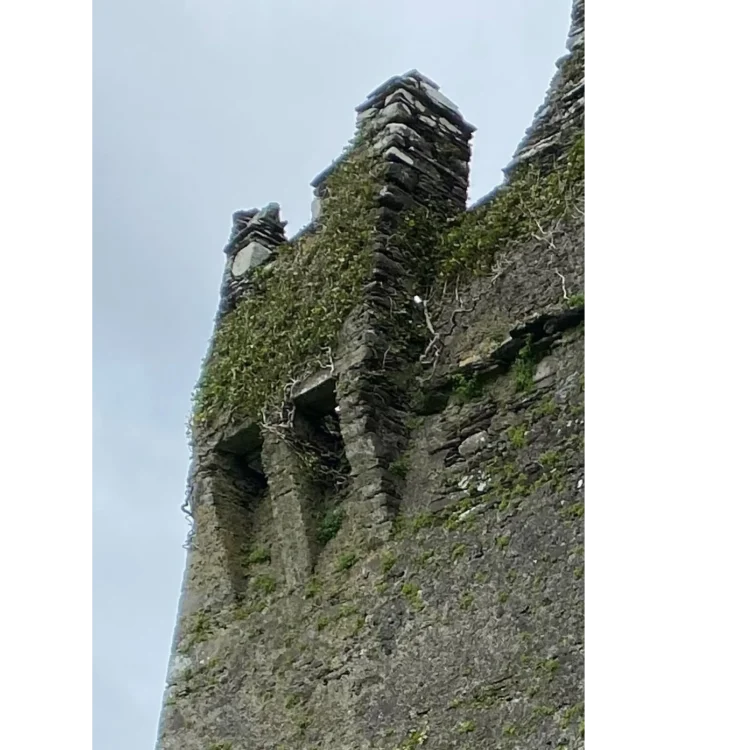
The structure itself is a fortified tower house, with defensive features that include two bartizans and traces of machicolation. Above the front door is evidence of a portcullis slot – which was a vertical timber and iron grille typically found in medieval fortifications. A spiral stone staircase rises up through the tower with window embrasures, which were splayed angled window openings, they are found on all levels with fireplaces on the second and fourth storeys. Later use of one particular room for Catholic worship indicates the building adapted to changing political and religious conditions. Ballinacarriga Castle reflects the changing fortunes of Gaelic Irish families during the Tudor and early Stuart periods. Today it provides a layered record of family identity, clan power, conflict, faith, and everyday life in early modern Ireland. Nestled beneath the castles shadow is a picnic site and the local school.
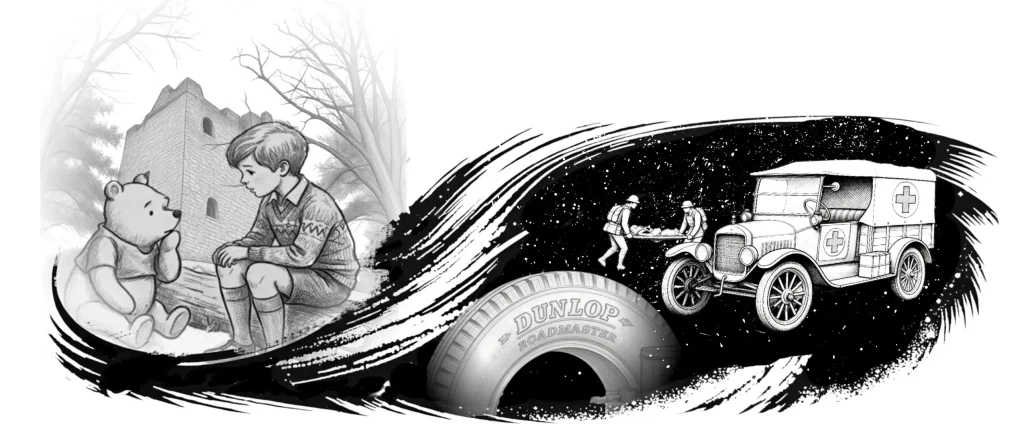
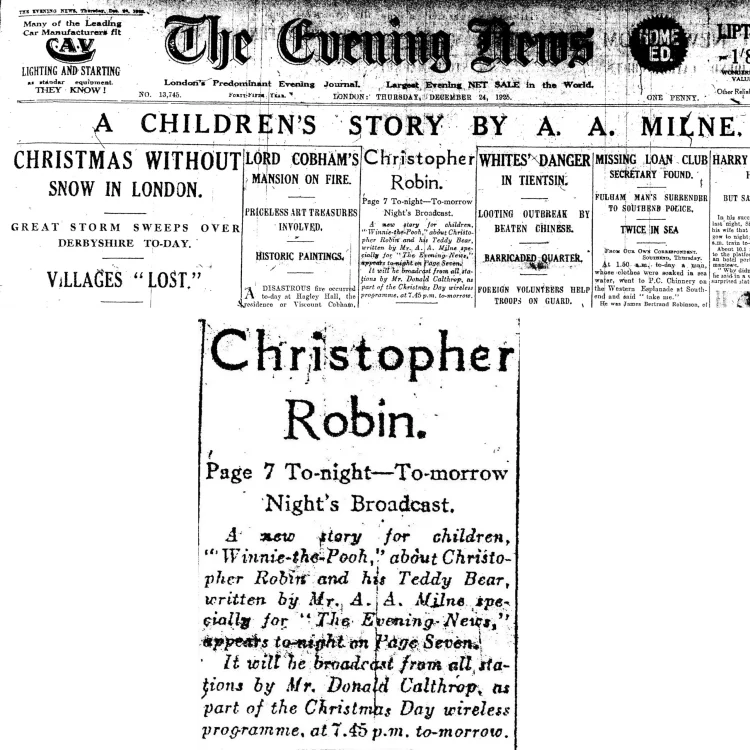
Once upon a time, a historian visited St. Joseph’s Cemetery in Dunmanway, intrigued by a grave she’d long wondered about given its shape and design. Her research indicated she found two uncles of the real Christopher Robin. Christopher Robin, A A Milne’s son and his teddy bear inspired the classic Winnie the Pooh stories.
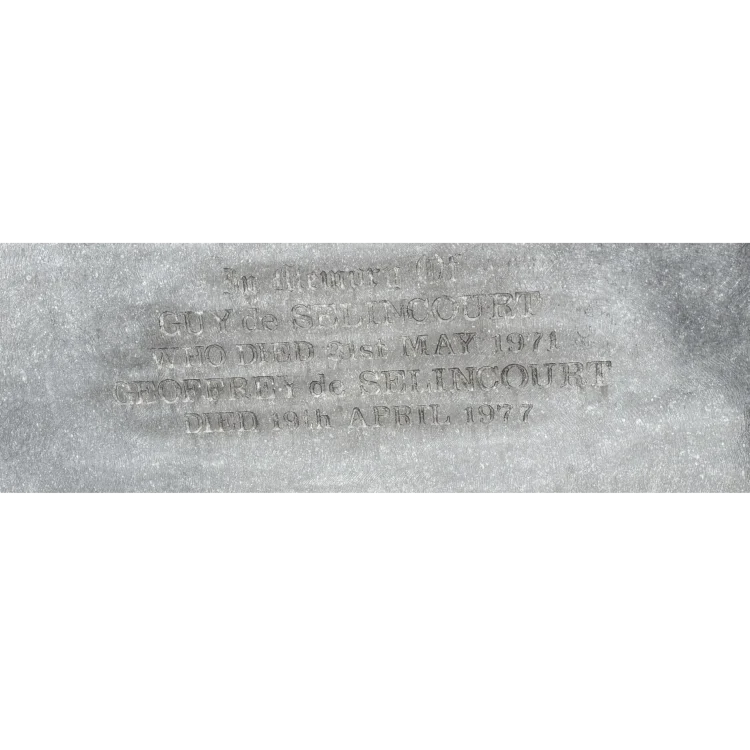
Guy and Geoffrey de Selincourt, brothers of A. A. Milne’s wife Dorothy, were artists whose lives are rarely discussed in the De Selincourt family history. Their retirement to Dunmanway and link to Pooh Bear’s creator went largely unnoticed until recently.
National Winnie the Pooh Day is celebrated on January 18th, marking A. A. Milne’s birthday in 1882. Milne published his first Winnie the Pooh stories in 1926, and by 1960 the books were New York Times Best Sellers. The tales are beloved for their simple charm and witty dialogue.
Alan Alexander Milne married Dorothy de Selincourt in 1913. Two of Dorothy’s siblings, Guy and Geoffrey, retired to Dunmanway in the 1960s with friends who had likely served in the military.
Guy de Selincourt, born in London in 1902 was an illustrator, author, historian, and sailor. Though he didn’t illustrate the Winnie the Pooh books, he created illustrations for his family and other authors. Known for his height, locals recall him driving his car from the back seat after removing the front seat to fit his long legs.
Geoffrey, born in 1900, and was also a painter. Many De Selincourt siblings served in major WW1 battles like the Somme and Gallipoli. Their brother Aubrey was shot down by German flying ace Werner Voss and became a POW; he later wrote books, often illustrated by Guy. Aubrey was a classical scholar who translated works such as The Life of Alexander the Great and Herodotus into English.
Guy and Geoffrey visited Cyprus and Europe before retiring in Dunmanway. Their experiences in Cyprus inspired them to create several oil paintings.
Guy and Geoffrey belonged to a family with strong literary roots; their uncle, Ernest de Selincourt, was a renowned poetry professor at Oxford and editor of Wordsworth’s letters, as well as Virginia Woolf’s teacher. Their father, Martin de Selincourt, owned the iconic Swan & Edgar premises in London, later taken over by Debenhams around 1928. He went on to chair the Debenham Trust, and was the first chairman of Geographical Magazine.
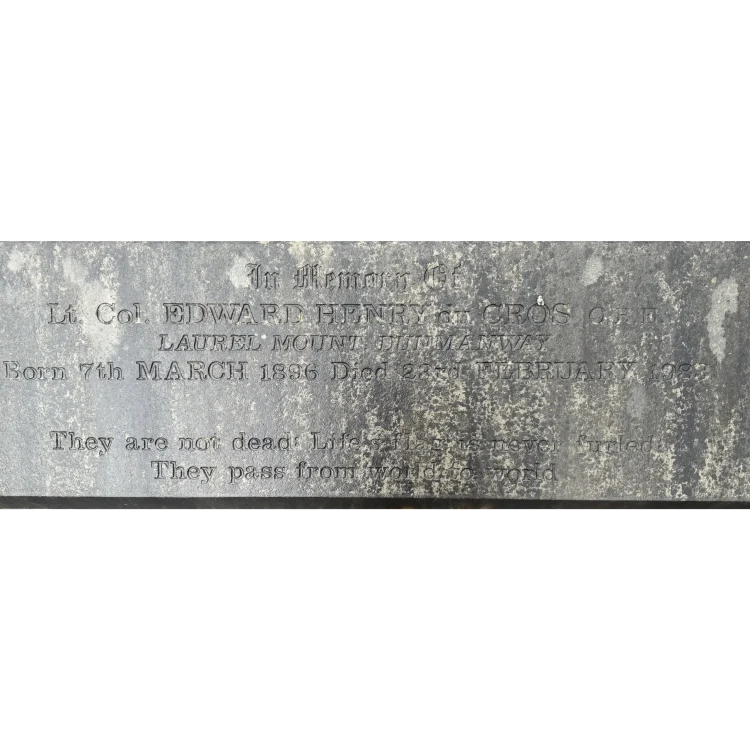
Another notable burial in St Joseph’s cemetery is that of Lieutenant Colonel Edward Henry Du Cros, friend of the De Selincourt brothers. Du Cros was a retired military man who had served in the first world war in France with the Leinster Regiment and later seconded to the Royal Engineers, most likely because of his mechanics skills. He later served in Egypt. Edward Henry Du Cros born in Yorkshire in 1896. His father had moved there as a mechanic.
The Du Cros family from Dublin, were originally of French Huguenot descent and are renowned for their contribution to First World War, the creation of Dunlops, the advancement of the pneumatic tyre and their many links with the automotive industry, with names such Goodyear Tyre and Rubber Company and Austin Motor Company among their business partners.
Edward was the nephew William Harvey du Cros – a Dublin-born financier who became the founder of the pneumatic tyre industry by developing the innovations of John Boyd Dunlop and mass-producing Dunlop’s tyres and creating the Dunlop company. Edward retired to Dunmanway in later years to join his friends, the De Selincourts and the Paynes while his brother was a clergyman in County Cork. His grandmother was also of Cork heritage.
The Du Cros family are famous also for their organisation of the voluntary unit known as the Du Cros convoy of ambulances that rushed to provide medical aid to and from the front line in World War One. Du Cros ambulances were made more efficient by using the new pneumatic tyre to traverse the rough terrain of the battlefield. Organised and financed by Edward’s cousins, two sons of Dunlop Tyre founder, William Harvey Du Cros. The Convoy was staffed largely by expert mechanics from their taxicab business in London. They revolutionised field transport. The Du Cros family also made many contributions to sport including Irish Rugby, Irish Fencing and Du Cros’s formed a successful team of racing cyclists known as the Invincibles.

To download the full set of colouring sheets from the Dunmanway Stories on the Street Series, click here: