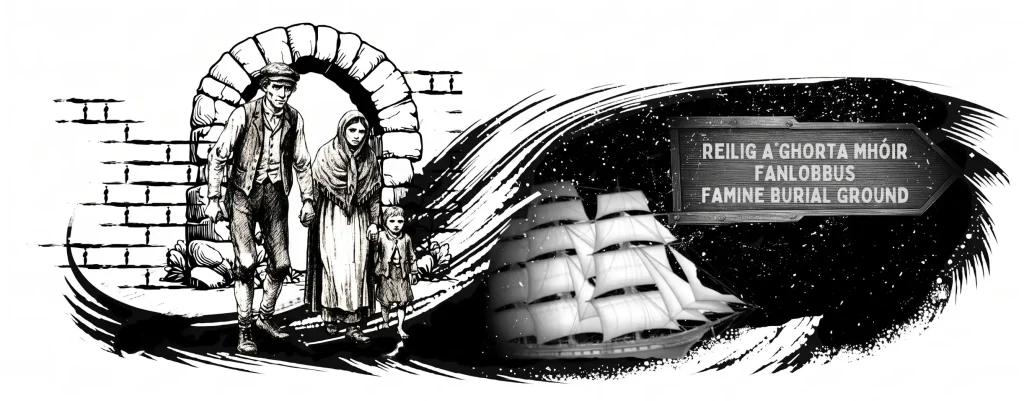

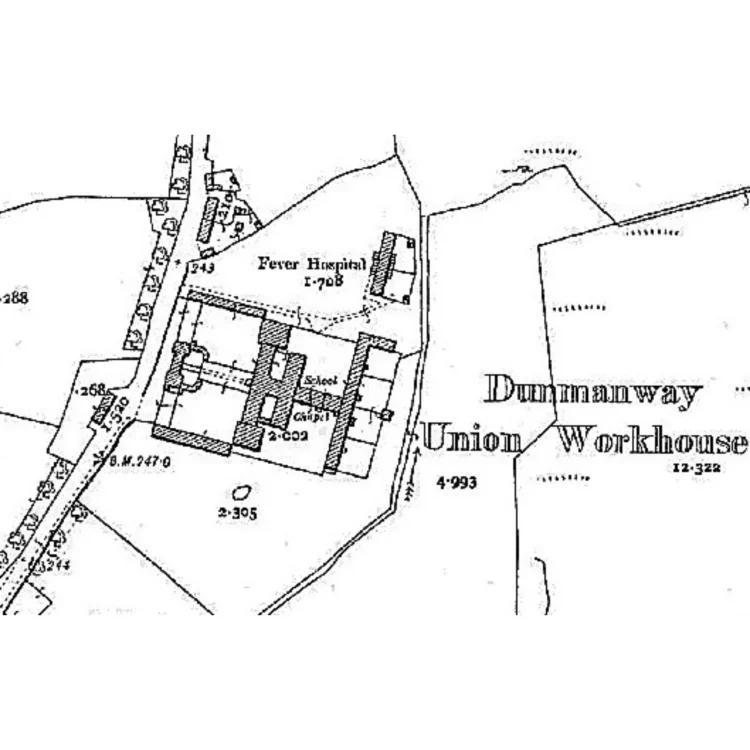
Dunmanway’s Famine Years are best understood by exploring the ruins of the Poor Law Union Workhouse found to the rear of the community hospital. Information signs there will offer insights into life during the Famine including the story of the 14 orphan girls , sent to Australia during the Great Hunger. An information board located at the 6th Century Fanlobbus Ecclesiastical Site located a short drive away provides further information on the Famine burials pits. Here early Christian archaeology and monastic life can be explored.
Irish Workhouses were established under the Poor Law Act of 1838. Dunmanway Workhouse, like all workhouses, was designed by George Wilkinson. It opened in December 1839 on a six acre site serving a catchment area of 140 square miles with over 30,000 people. Completed by 1843, it accommodated 400 paupers, though numbers often doubled during the famine. On 2 December 1843, there were 163 residents. The importance of these workhouses grew unexpectedly during the Great Famine.
The Poor Law Union was managed by a Board of Guardians, with daily operations handled by the Master and Matron. Clergy and medical staff attended to inmate welfare. The building had separate wards for men, women, boys, and girls, with children separated from their parents. Children were educated on site.
Upon arrival inmates’ details, health, and general appearance were recorded. They received uniforms and were informed of the rules and the consequences for breaking them. Sleeping conditions consisted of straw mattresses on wooden platforms, with poor ventilation and sanitation. Overcrowding during the Famine Years led to worsening conditions and increased disease and mortality.
The Chapel, now known as the Famine Memorial Chapel Room, also served as a dining area. Departments like spinning, milling, laundry, carpentry, rock-breaking, shoemaking, and dressmaking operated on site, where inmates worked for their rations.
1847 is known still as Black ’47, the worst year of the famine, it saw 866 people housed in the main workhouse and a further129 in the Fever Hospital on March 27 – 1847. The Fever Hospital played a crucial role during the typhoid outbreak, with 59 deaths in one week in May 1847. Later in 1849 the Fever Hospital was strained by the cholera epidemic then rampant across Ireland.
In the years after the famine – the workhouse continued to a play a similar role until the building became a County Home and more akin to a hospital in 1919. One of the earliest acts of the First Dail in 1919 was to remove the term -Workhouse.
In Autumn 1845, the potato blight destroyed the potato harvest. Fanlobbus became a pivotal burial site in the area then. However, its broader monastic and archaeological history is less well known.
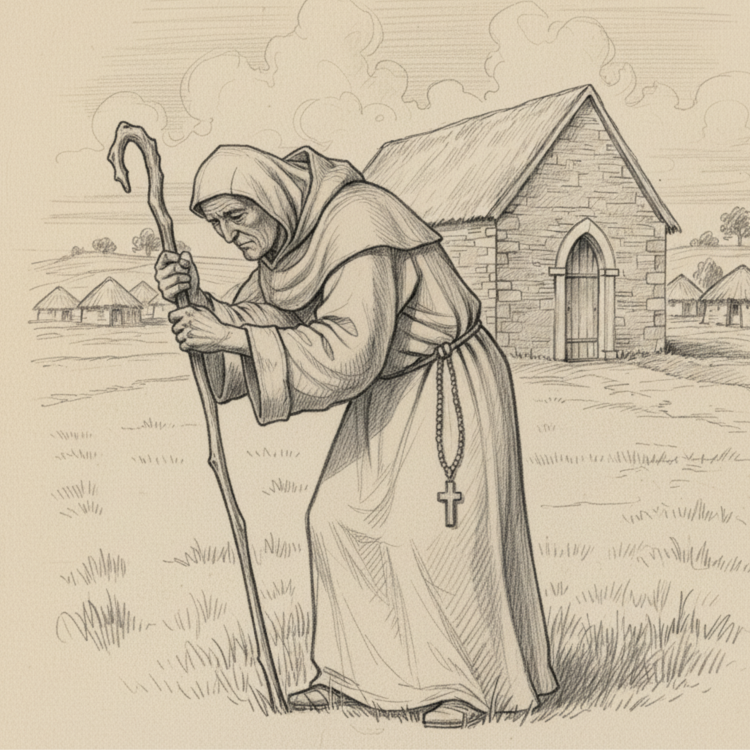
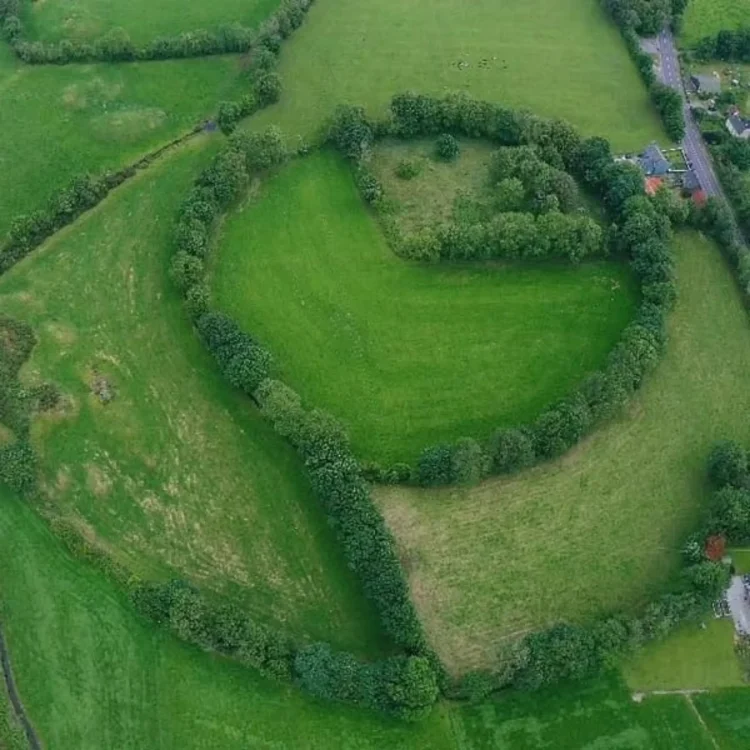
The name Fanlobbus is sometimes translated as the slope of the fawn’s bed or the slope of the leper. Ancient texts suggest there was a leper colony in the vicinity. There also is a folklore connection to the race known as the Fomorians. These were a mythological race of giants, sea raiders and supernatural beings. Saint Goban Corr, a 6th-century cleric, is credited with founding the first monastic settlement there. The word Corr suggests he had a stooped posture, most likely from years residing in small monastic cells.
Saint Finbarr (550–623) later acquired oversight of the monastic settlement. It also had links to the diocese of Kinneigh and was mentioned in a letter from Pope Innocent III dated 1199. Today, only a quadrant of the original settlement is evident. Fanlobbus is an example of a double ring enclosure.
Under Elizabeth I -1558-1603, most Catholic churches in the greater Carbery area were dissolved. Catholic clerics left the area; while others performed their duties in secret at mass rocks during the Penal Laws .
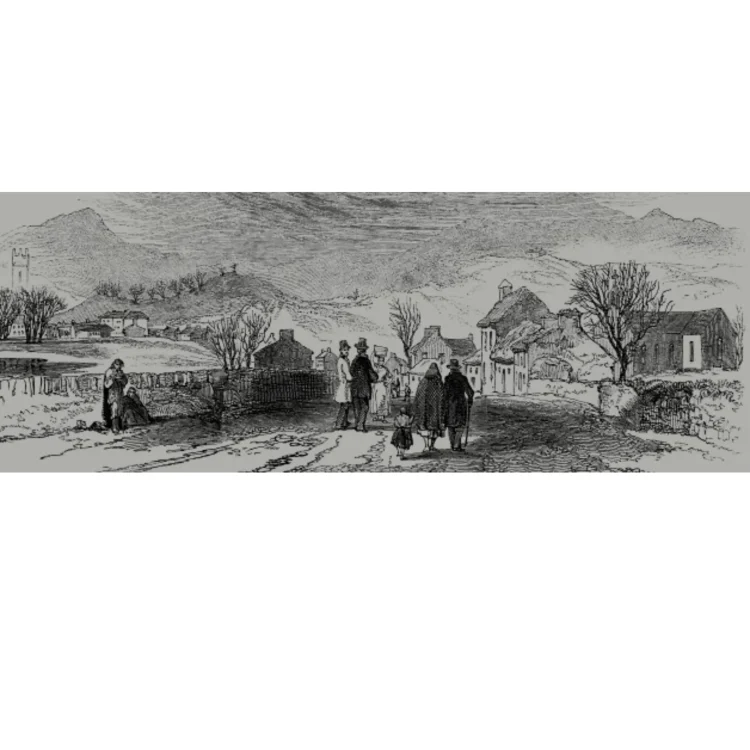
By 1678 – Sir Richard Cox (1650-1733), First Baronet, Lord Chancellor of Ireland founded the town of Dunmanway and many people in the area migrated away from Fanlobbus settlement towards the new town.
In 1843 -John Windele, respected Cork antiquarian noted that “of the extensive burial grounds, nothing remains of the old building but the ruin of the doorway .. erected in the 11th century.”
Meanwhile in 1846 – the second potato crop failure saw increasing numbers of paupers seek admission to the dreaded workhouse . In May of 1847- 59 inmates died in a single week, this involved multiple burials per-grave .
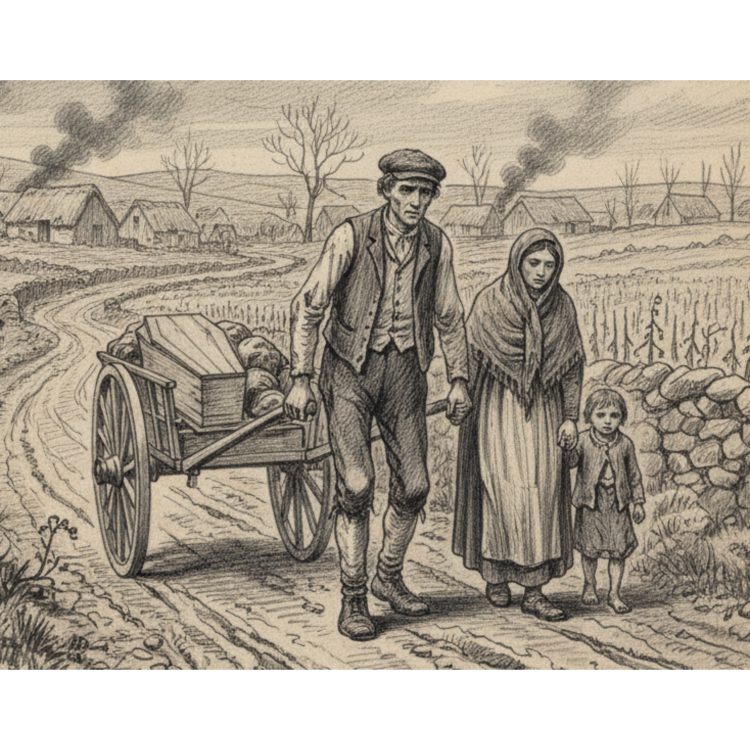
Victims from the workhouse were taken discreetly via a gravel path through the fields by horse and cart, to the Graveyard. The remnants of the “Famine Pits” are still visible today. An Information panel is located at the graveyard.
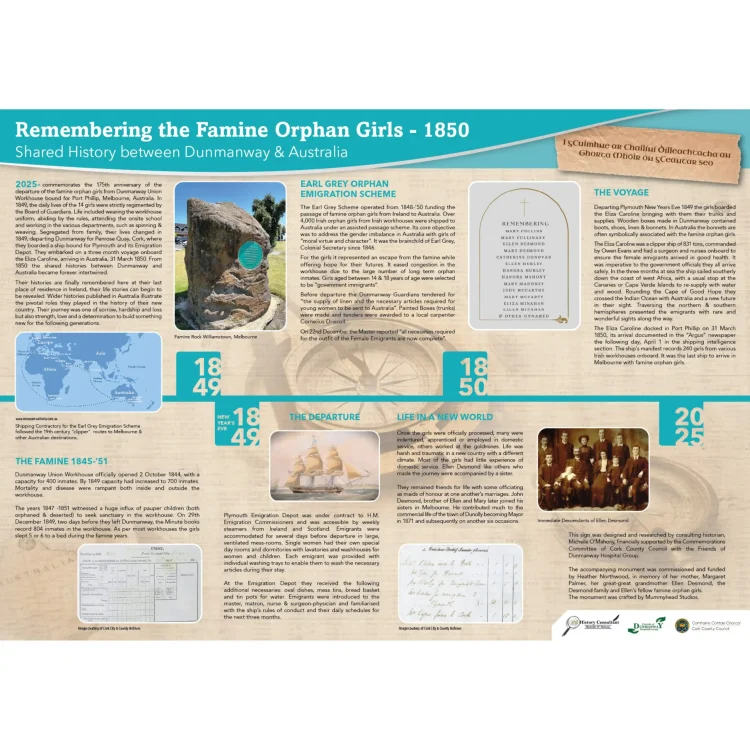
In the Winter of 1849, 14 orphan girls at Dunmanway Workhouse saw their lives transformed when they left for Port Phillip (now Melbourne). Selected under the Earl Grey Assisted Passage Scheme for Orphan Girls. This program, launched by Colonial Secretary Earl Grey, brought over 4,000 Irish orphan girls to Australia between 1848 and 1850. It gave the girls a chance to escape famine, build new futures, while also reducing overcrowding in Irish workhouses.
Fourteen Dunmanway girls, aged 14 to 18, were chosen as “government immigrants.” Before leaving, workhouse Guardians arranged for linen and other essentials for them. Painted boxes and trunks were crafted by local carpenter, Cornelius Driscoll. By December 22nd, all provisions were ready. Just before Christmas 1849, the girls waved goodbye to Dunmanway and left by horse and cart for Penrose Quay, Cork, to board a steamer to Plymouth.
Upon arrival at Plymouth Emigration Depot, the girls stayed in ventilated mess-rooms and received further supplies for the next leg of the voyage. They met their accompanying staff consisting of master, matron, nurses and surgeons and were briefed on ship rules and daily routines for the three-month journey that lay ahead.
On New Year’s Eve 1849, the girls , their trunks and worldly possessions boarded the Eliza Caroline, a clipper ship of 831 tons, commanded by Owen Evans . Their trunks contained essentials like boots, shoes, linen, and bonnets—bonnets now symbolically linked with famine orphan girls in Australia. The ship sailed south along West Africa, stopped at the Canaries, sometimes Cape Verde for water and wood, rounded the Cape of Good Hope, and crossed the Indian Ocean toward Australia, offering emigrants rare sights throughout their journey.
The Eliza Caroline docked at Port Phillip on 31 March 1850. Its manifest listed 240 Irish workhouse girls, including 14 from Dunmanway. This was the last ship to bring famine orphan girls to Melbourne.
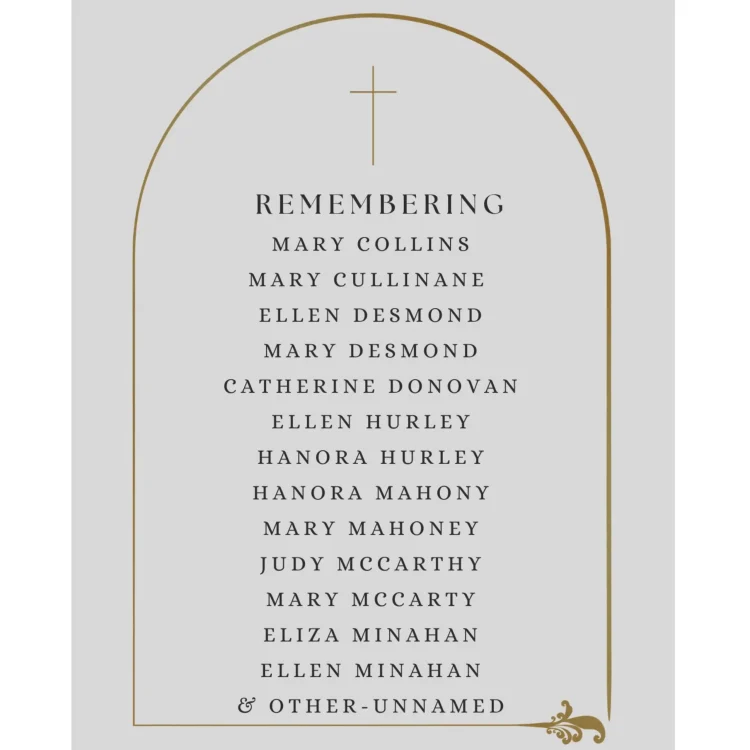
After official processing, many of the girls were indentured or employed in domestic service, while others worked at gold mines. Life in the new country was difficult and traumatic. Ellen Desmond and her sister Mary arrived together and maintained lifelong friendships. A monument at Dunmanway Community Hospital was established in 2025 by Ellen’s great-great granddaughter to honour Ellen, Mary, and the twelve other orphan girls .
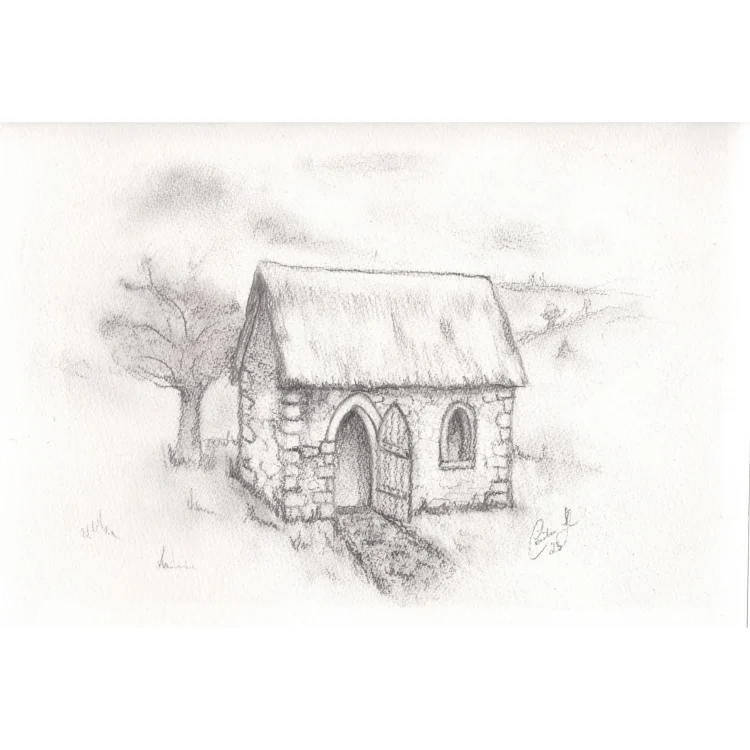
To download the full set of colouring sheets from the Dunmanway Stories on the Street Series, click here: