Plaque 8: The Legendary Sam Maguire
School:
The Model School
Characters:
Setting:
The narrator and three pupils having a chat about the history of the Model School and the famous Sam Maguire who attended the Model School
Narrator : Let me tell you a little about the history of the Model School. Then we will hear from pupils Aoife, Cian and Jack who were having a chat about the legendary Sam Maguire who attended their school.
The Model School, located on the Bantry Road, has a very interesting history, it was built in 1848 in the later years of the Irish Famine by the Commissioners of National Education. It is an impressive building built in a neo- Tudor & Victorian style with a few additions over the centuries. When it opened it was a literary school, and it had an agricultural department and an adjoining Model farm. Boys and girls attended, with a headmaster and headmistress and a number of teachers. Many of the teachers lived on site. An agricultural superintendent gave agricultural classes daily to the older students. It also had boarding students. By the end of its first month in operation, it had 164 pupils. Within five years the school was overcrowded with over 260 pupils. It can boast a few famous past pupils. One in particular is the legendary GAA sportsman and political activist, Sam Maguire who’s name and trophy honours his contribution to Ireland’s National Game of Gaelic Football.
Cian:
Aoife, what famous person are you doing your history project on ?
Aoife:
I am doing mine on the Legendary Sam Maguire, one of Dunmanway’s famous sons.
Cian :
The one they named the All-Ireland football trophy after.
Aoife
Yes , That’s the man! Sam Maguire was born in 1877 in the townland of Mallabraca, up north of the town. He was the son of John Maguire and Jane Kingston, and he had six brothers and sisters, so his house must have been very noisy!
Jack
What did his parents do ?
Aoife :
They were tenant farmers, working on land owned by Colonel Shuldham, who lived at Coolkellure House.
Cian:
So- did he just spend his days milking cows and playing football? I suppose he learned farming here when they had the agricultural department and model farm here in the olden days.
Aoife:
They say that he was an excellent student – his teachers said he’d be perfect for the British Civil Service. Back then, that was a big opportunity. Students from the area even prepared for the exams in a special school at Ardfield.
Jack :
Did he pass those exams and what happened then ?
Aoife:
Yes! He joined the Civil Service in London and that’s where he really felt his identity as an Irishman. He started playing Gaelic football in London, joined GAA clubs, and helped organise them. But guess what—he played in many finals and never won an All‑Ireland medal!
Cian:
Talk about unlucky!
Aoife:
Politically, he became very active. It’s said that Sam introduced Michael Collins to the Irish Republican Brotherhood. He had great organisational skills, though some parts of his life are still a bit of a mystery.
Cian:
This sounds a bit like a secret agent with a football in his hand!
Aoife:
After the Treaty of 1922, he joined the Irish Civil Service in Dublin. But he argued so much with his bosses that he was dismissed and returned to Mallabraca in 1924.
Jack :
What happened then ?
Aoife:
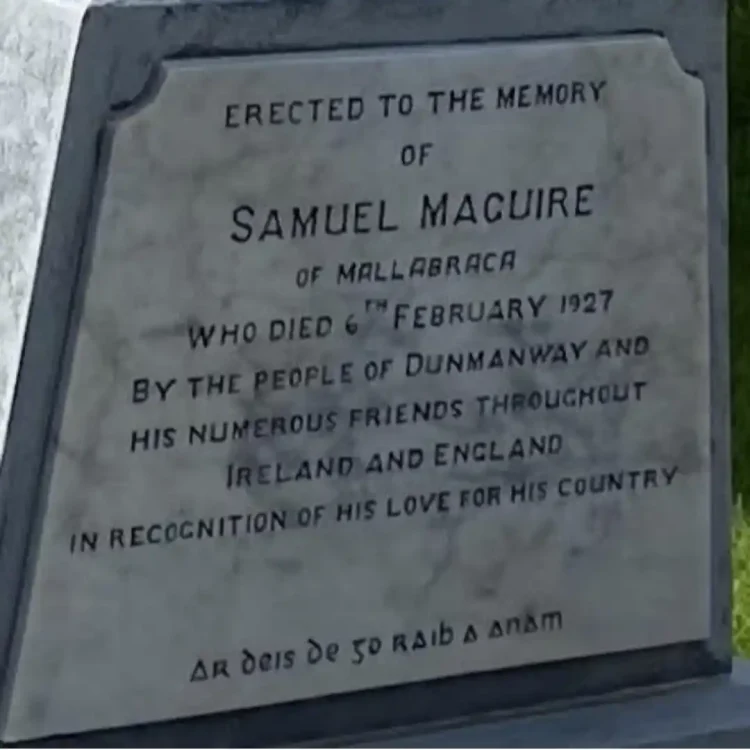
He returned to his home and died in 1927 at just 49 years old- it’s a bit of a sad story. He’s buried in Saint Mary’s Church of Ireland Graveyard on Main Street.
Cian:
Is that the church with the Cox family vault and Henry Cox’s name over the door?
Aoife:
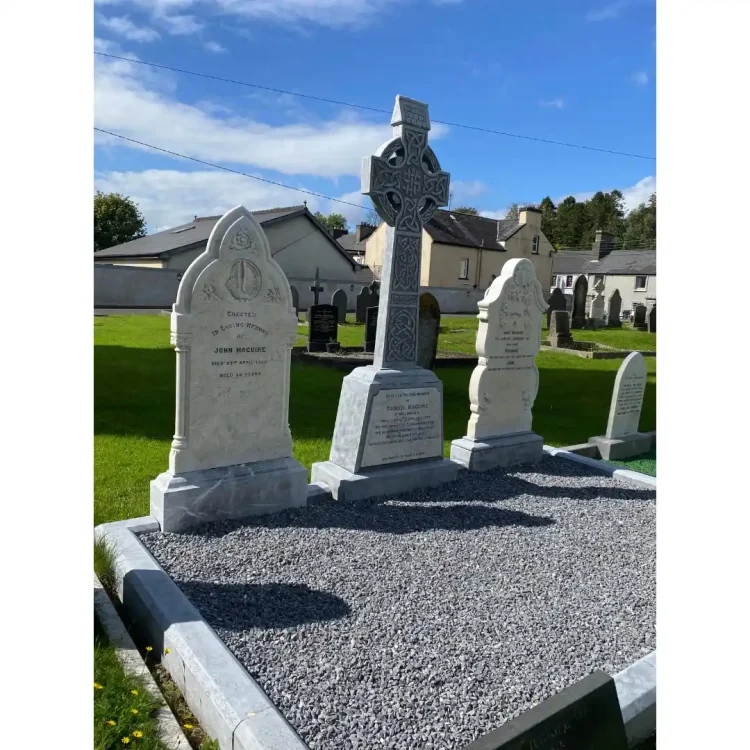
Exactly. The church was founded in 1821 by Henry Cox. Sam and his family were regular worshippers there. In 1949, people put a Celtic Cross on his grave to honour his work for the GAA and Irish nationalism. In 1974, they opened Sam Maguire Memorial Park in town.
Jack
Where does the Sam Maguire Cup come into the story?
Aoife:
His friends commissioned the Sam Maguire Cup, inspired by the Ardagh Chalice, and made from silver. It was first awarded in 1928 to County Kildare. In 2002 his statue in the Square was unveiled.
Cian:
And what about the bells- why are they called the Sam Maguire Community Bells?
Aoife:
In 2017, the community paid for eight new Sam Maguire Community Bells in St Mary’s Church. Two of them are inscribed “Sam Maguire 1877–1927”, and each of the 8 bells reflect themes of Dunmanway’s heritage—Sport, War and Revolution, Agriculture, People, Migration, Religion, Education and Arts, and Industry and Commerce.
Jack:
So, every time those bells ring, it’s like Dunmanway is saying, “Don’t forget Sam!”
Cian:
Thanks for telling us the story of Dunmanway’s Giant of sport and history!

![A front-on, close-up photograph shows a framed, rectangular military award certificate (Legion of Merit) presented on slightly aged, off-white paper. The document is mounted inside a simple, thin black frame against a plain white wall.At the top centre of the certificate, there is a coloured illustration of the United States Legion of Merit medal suspended from a wavy red ribbon with white borders. Small, faint five-pointed stars are printed in the upper left, upper right, lower left, and lower right corners of the page border. At the bottom centre, a circular, embossed official seal of the United States War Office is visible. Two handwritten signatures in dark ink appear at the bottom, one on the left and one on the right, above printed titles. Transcribed TextTHE UNITED STATES OF AMERICA TO ALL WHO SHALL SEE THESE PRESENTS, GREETING: THIS IS TO CERTIFY THAT THE PRESIDENT OF THE UNITED STATES OF AMERICA IN ACCORDANCE WITH THE ORDER ISSUED BY GENERAL GEORGE WASHINGTON AT HEADQUARTERS, NEWBURGH, NEW YORK, ON AUGUST 7, 1782, AND PURSUANT TO ACT OF CONGRESS, HAS AWARDED THE LEGION OF MERIT Degree of Officer TO Group Captain Charles Beamish, Royal Air Force FOR EXTRAORDINARY FIDELITY AND EXCEPTIONALLY MERITORIOUS CONDUCT IN THE PERFORMANCE OF OUTSTANDING SERVICE GIVEN UNDER MY HAND IN THE CITY OF WASHINGTON THIS 27th DAY OF February 1946 RECORDED IN THE OFFICE OF [Signature: Edward F. Witsell] Major General The Adjutant General [Signature: Robert P. Patterson] Secretary of War](https://dunmanwayhistoricalassociation.ie/wp-content/uploads/elementor/thumbs/Plaque_8_Charles-Beamishs-Legion-of-Merit-Award-Certification-roer5f7t058adffb4p3kt3pb3suca2r8z507821y30.webp)