
St Mary’s Senior Girls School
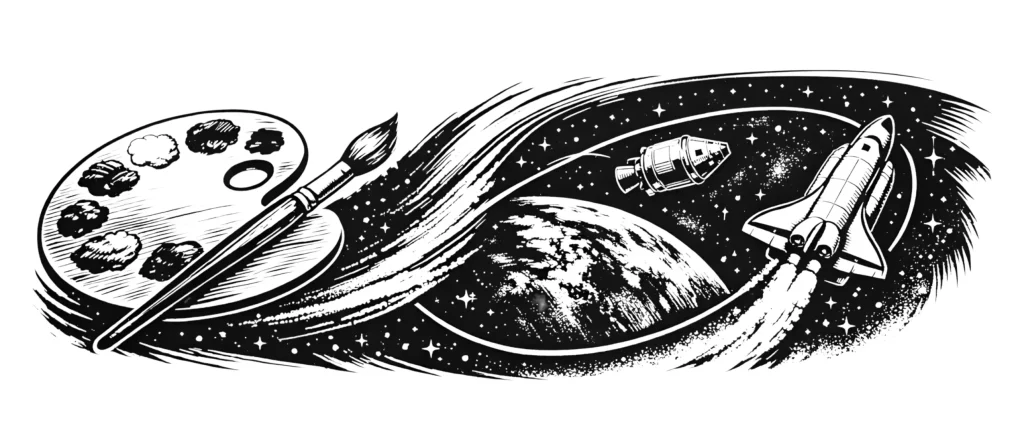
School corridor in Dunmanway, outside a classroom with a big NASA poster on the door.
Aoife: Look at that poster – rockets, planets, everything. Hard to believe people from around here are actually part of that story.
Ciara: Remember – the time you told the teacher we should rename Dunmanway “Spaceway”?
Niamh: Hey, it kind of fits! We’ve got two NASA legends with Dunmanway roots: Eileen Collins and Michael Collins.
Aoife: Different Collins families, same idea – straight from West Cork to outer space.
Ciara: So remind me, what’s the story with Eileen again?
Niamh: Eileen Marie Collins was born in New York in 1956, but her great‑great‑grandad Jeremiah Collins came from the Lisbealad/Drinagh side of Dunmanway. His wife was probably from Kinneigh. They emigrated to America in the mid‑1800s.
Aoife: Their great‑great‑granddaughter ends up flying the Space Shuttle. I bet when they left famine Ireland, “space pilot” wasn’t on the family plan.
Ciara: Didn’t she actually visit Cork?
Niamh: Yeah, and members of the Dunmanway Historical Society met her. Imagine being the person who says, “Welcome home, Commander.”
Aoife: And she really had to graft. Her family struggled for money, so she paid for her own flying lessons at first.
Ciara: She went to Syracuse and Stanford universities , became a maths instructor at the Air Force Academy, and a test pilot also.
Niamh: NASA picked her in 1990 to be an astronaut. In 1995 she became the first woman to pilot a space shuttle, and was honoured by President Clinton at the White House. In 1999 she commanded the Columbia mission STS‑93 – making history as the first woman ever to command a shuttle.
Aoife: Five days in space, taking ultraviolet pictures of Earth, the Moon, Mercury, Venus and Jupiter, and checking how plants grow up there.
Ciara: I love what she said: “I want to do well because I know I’m representing other women, other pilots.”
Niamh: And she’s loaded with awards – Distinguished Flying Cross, NASA medals, even the French Legion of Honor.
Aoife: Okay, your turn, the other Collins.
Ciara: Michael Collins, Apollo 11. Born in Rome in 1930, piloted the command module while Neil Armstrong and Buzz Aldrin walked on the Moon.
Niamh: His grandfather, Jeremiah Bernard Collins, came from Droumdrastill near Dunmanway and left as a boy in the 1860s. He ended up in Ohio, then fought in the American Civil War as a drummer boy and later drove horses to Texas.
Aoife: He ended up in New Orleans, working for a grocer called James Lawton, he married the boss’s daughter Kate, and together they ran a shop with a pub in the back. Eleven kids – a big Irish family!
Ciara: One of those kids was James Lawton Collins, who became a Major General in the U.S. Army, served in both World Wars, and was stationed in Rome when Michael was born.
Niamh: So: from post famine‑era Dunmanway, to astronaut Michael Collins, piloting the first Moon landing -that’s not bad for a “small place in West Cork.”
Aoife: Between Eileen and Michael- I’m starting to think Dunmanway’s real export wasn’t linen or leather – it’s astronauts !!
Ciara: Grand plans so. I’ll be the first girl from Dunmanway on Mars.
Niamh: I’ll design your mission patch.
Aoife: And I’ll write the history talk. The Dunmanway space connections.
St Mary’s Senior Girls School
Art room in a Dunmanway school. The children are working on drawings while chatting.
Aoife: My hand is wrecked from all this shading. Our teacher says, “The more you shade, the more you see.”
Kate: That’s because of the new hero artist we learned about, what’s-his-name… Thomas Hovenden?
Mia: Yeah, the famine orphan from Dunmanway who became a famous painter in America. I still can’t believe he started out right here in Dunmanway!
Aoife: He was born on 28 December 1840, just down the road, in the old Bridewell on Main Street. His dad, Robert, was the gaolkeeper and his mam, Ellen Bryan, was the daughter of a Methodist minister.
Kate: So, he literally grew up in a prison?
Mia: Well Kind of. The building still looks like a Victorian gaol, with that carved stone front. Imagine playing hide-and-seek there.
Aoife: Not very cosy, especially during the famine. In 1846–47 both his parents died from famine illnesses, and he and his brother John and sister Elizabeth were sent to an orphanage in Cork City.
Kate: That’s awful. So how did he go from being in an orphanage to becoming one of America’s most famous artists?
Mia: In Cork, the teachers spotted he was great at drawing. He was apprenticed to a gilder called Tolerton. Tolerton helped him get into the Cork School of Design around 1860, maybe because of this amazing drawing he did of the Venus de Milo.
Aoife: Some of his early watercolours and that Venus drawing turned up in exhibition catalogues later, even in the Smithsonian, while he was living in New York.
Kate: Our teacher said he was known for his shading technique, hiding little details in the dark bits so the more you look, the more you see. That’s why she’s making us shade till our hands fall off.
Mia: Then he emigrated in 1863, from Queenstown—Cobh now—on a ship called the City of Baltimore. He lived in Philadelphia, Baltimore and New York, and studied art in Paris under a big-name painter, Alexandre Cabanel.
Aoife: He even lived near the famous Louvre. In 1875 he met another artist, Helen Corson, in Brittany. They married, had a son and a daughter, and he became a professor of painting at the Pennsylvania Academy of the Fine Arts. He was made an American citizen in 1887.
Kate: From a Famine orphan to a professor in America. That’s some change.
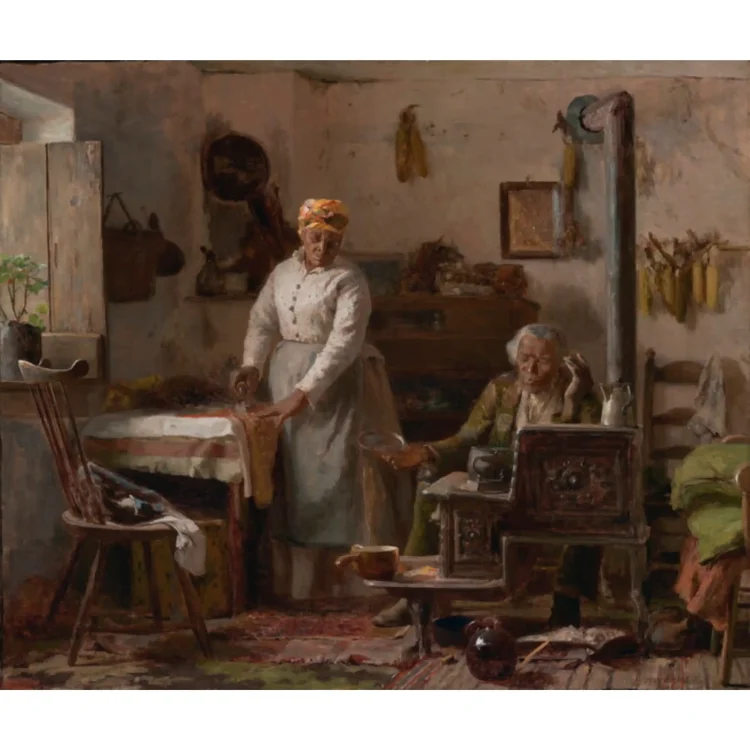
Mia: He painted over a hundred works about everyday life and especially African American people. In “Chloe and Sam” he showed coloured domestic life with real tenderness and respect, which was unusual at the time.
Aoife: And “The Last Moments of John Brown” shows the abolitionist , Brown , on his way to be executed. It is in in The Met Art Gallery in New York.
Kate: My favourite painting is the one he called “Breaking Home Ties” – the one with the boy leaving his family farm. It was voted the most popular painting at the Chicago World’s Fair in 1893.
Mia: Hovenden’s death notice in a Cleveland paper called him a “hero artist.” They said no one should be surprised that he died trying to save a child, because he’d always been a compassionate and “obscure” hero of people.
Aoife: That’s how he died in 1895 – hit by a train while trying to save a young girl.
Kate: He sounds brave.
Mia: His fame faded for a while, but during the Civil Rights era people got interested again in how kindly he painted African Americans and our teacher has got interested in his work.
Kate: It’s a great story but my hand is sore from shading
Mia: Oh well – if Thomas could draw in an orphanage and a gaol, we can survive double art on a Monday.
To download the full set of colouring sheets from the Dunmanway Stories on the Street Series, click here: