
The Lakeside area has a diverse history. Saint Patrick’s Church as we know it today was built under the pioneering and watchful eye of Father James Doheny, in 1834.
Father Doheny, known for his outspokenness and willingness to take risks, is honoured by a plaque inside St Patrick’s Church. Born in Tipperary in 1786, he served as parish priest from 1818 for 30 years. The church he found on arrival was built in 1793 on land obtained from Henry Hamilton Cox by Father Coghlan. The story goes as follows :-
The Penal Laws, starting in the late 1600s, forbid Catholicism. By the late 1790s these laws eased, allowing the local priest to hold mass in a small, thatched cabin near the long bridge. A descendant of Sir Richard Cox -the town’s founder, called Henry Hamilton Cox, witnessed many Catholics trying to enter into this tiny cabin to attend mass, with many kneeling along the long bridge and roadside. Overcome with compassion he realised these were his tenants and offered Father Coghlan a lease of land for a church. A small church was established on Cox’s land where Saint Patrick’s Church now stands.
Father Doheny, appointed in 1818 set about a building programme. By 1834, Father Doheny had built a new Church. In appointing Father Doheny, Bishop Murphy was aware of Doheny’s reputation for being zealous, hardworking and caring. He also built Togher and Ballinacarriga Churches.
Father Doheny , never afraid to speak his mind, had much influence over the community . He feared political extremism and often spoke out against the agrarian agitators. His friends included the Liberator- Daniel O’Connell, William Joseph O’Neill Daunt – the Personal Secretary to O’Connell who was also co-founder of the Repeal Association, and the temperance advocate Father Mathew. Like Daniel O’Connell he believed in constitutional means to obtain relief from the oppression of English laws. As an advocate of the tithe war, he held a meeting in 1832 in the church grounds that was attended by “thousands”. His speech was called the “Great Repeal and Tithe meeting” and it made headlines in the provincial newspapers.
In the 1830s, Father Doheny lived in Gurteenasowna with his sister Alice, who was his housekeeper, and his brother Thomas and family joined him thereafter. Thomas’s daughter – Mary, took up the role as housekeeper and inherited his property. Local lore reveals that it was Mary who provided the hospitality for Daniel O’Connell & Father Mathews’s visits to Dunmanway. Father Doheny leased land at Doheny’s Lane for himself and the family who were experiencing financial difficulties. Father Doheny retired in 1848, residing at Lakelands until his death- at 80 years of age. Headlines in the Cork Examiner for April 7th 1866 – read as follows “Father Doheny’s works live after him and few men have worked harder .. than this worthy priest.”. The location of his burial is a source of speculation and remains unknown. While his family are buried in the Doheny Plot adjacent to the church.
In the 1820s and 1830s two great Irish social and political movements appeared on the scene, Daniel O Connell and Catholic Emancipation and the Total Abstinence Society of Father Theobald Mathew. Both experienced successes. On the 20th February 1841, Father Mathew, a friend of the local priest Father Doheny and fellow native of Tipperary, preached in the newly erected Saint Patrick’s Church. The subject of his speech featured abstinence from alcohol and also the elimination of the debt and building costs of the new Church but also to get further support for its completion. All the clergy in the surrounding areas attended. Father Mathew was warmly received when he appeared at the altar. Following his sermon, Father Mathew proceeded to a platform in the front of the church, the yard was overflowing with people. A crowd of over two thousand people had gathered to greet Father Mathew. The visit had been well publicised and people travelled from Bandon, Clonakilty, Bantry and Skibbereen to hear him speak. Following the speech at the platform, many advanced to recite and take the pledge of abstinence.
Councillor O’Sullivan of Bridgemount was the first to take the pledge. Father Mathew continued to administer the pledge well into the night and then returned to Father Doheny’s home at Lakelands. The next day Father Mathew returned to again administer the pledge and by the evening it was estimated more than two thousand persons had taken the pledge. According to a newspaper report – the following day Father Mathew presented Father Doheny with a large donation for the chapel and fifteen pounds to buy instruments for the local Temperance Society Band in Dunmanway.
Father Mathew made return visits to Dunmanway in 1846 and at the end of 1847 – during the famine years.
Catholic Emancipation was the process in the late 18th and early 19th centuries that removed many legal restrictions on Catholics in Britain and Ireland. It culminated in the 1829 Catholic Relief Act, which allowed Catholics to vote, hold public office, and sit in Parliament, ending centuries of civil and political discrimination. Daniel O’Connell was elected as MP for County Cork in 1841 and represented the constituency until his death in 1847. This was one of several constituencies he sat for in the House of Commons, having previously been MP for County Clare, Waterford City, Kerry, Dublin City, Kilkenny City, and Meath.
As Cork’s MP he continued his two main campaigns: Catholic Emancipation, which he had already helped win, and the Repeal of the Act of Union, calling for an independent Irish Parliament. A year later, O’Connell’s advisors advised he hold a Monster Repeal meeting in West Cork. In May 1843, a west Cork delegation including Father Doheny asked for a date to be set for a meeting. Skibbereen was chosen as the venue, the date – June 22nd, 1843.
Daniel O’Connell left Cork City on the morning of Wednesday 21st and arrived in Dunmanway that afternoon. It was the first day that O’Connell had visited this particular area known then as the Carberies. The journey was not without complications. It was peaceful until O’Connell reached Ballineen where there was a little disruption. There was anticipation of further disruption in Dunmanway and some of the town’s Dragoon Regiment were on standby.
During his overnight stay at Dunmanway, O’Connell was the guest of his friend, Father Doheny at his home in Lakelands. In the morning O’Connell was greeted with an audience and was addressed by to those gathered. The address to him was composed and read by Councillor O’Sullivan of Bridgemount House. O’Connell departed Dunmanway before noon accompanied by Father Doheny and others. While at Lakelands O’Connell was entertained by Father Doheny’s niece Mary, who had a reputation of being an excellent hostess, cook and a lady of literary refinement.
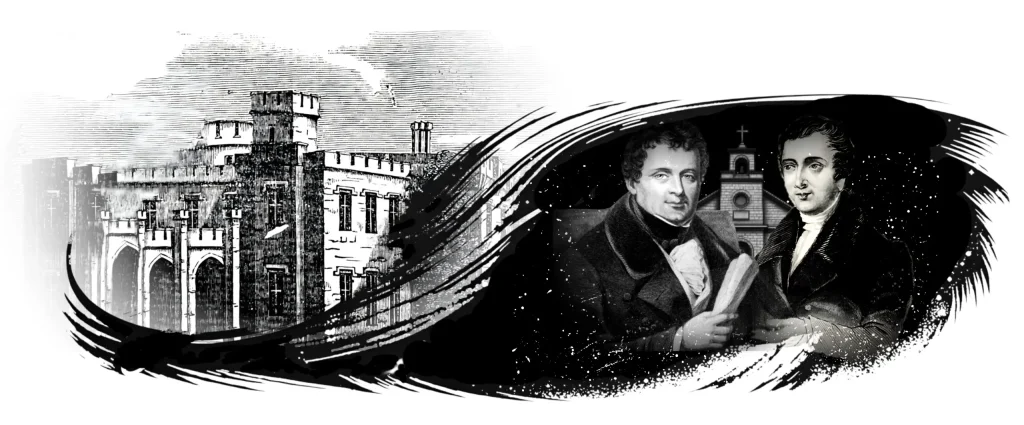
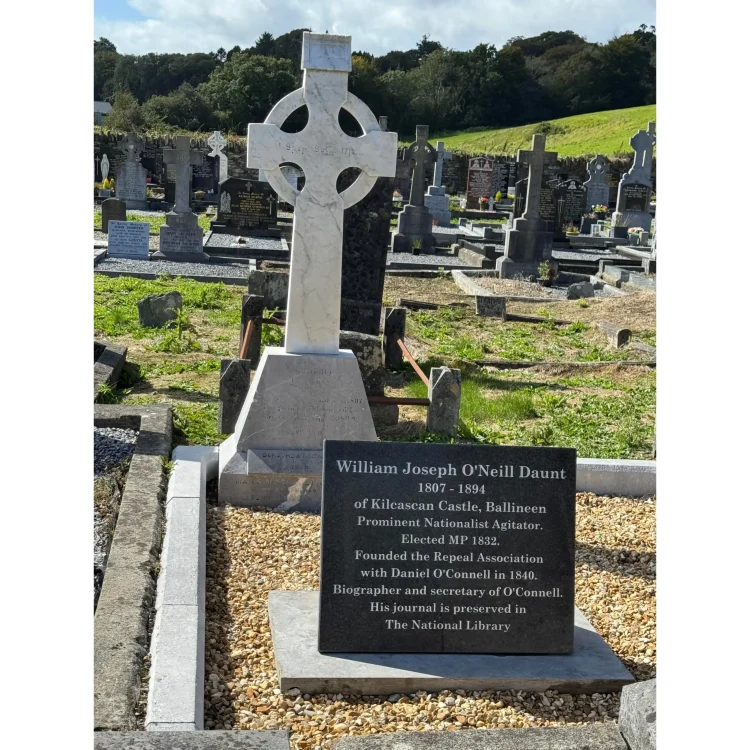
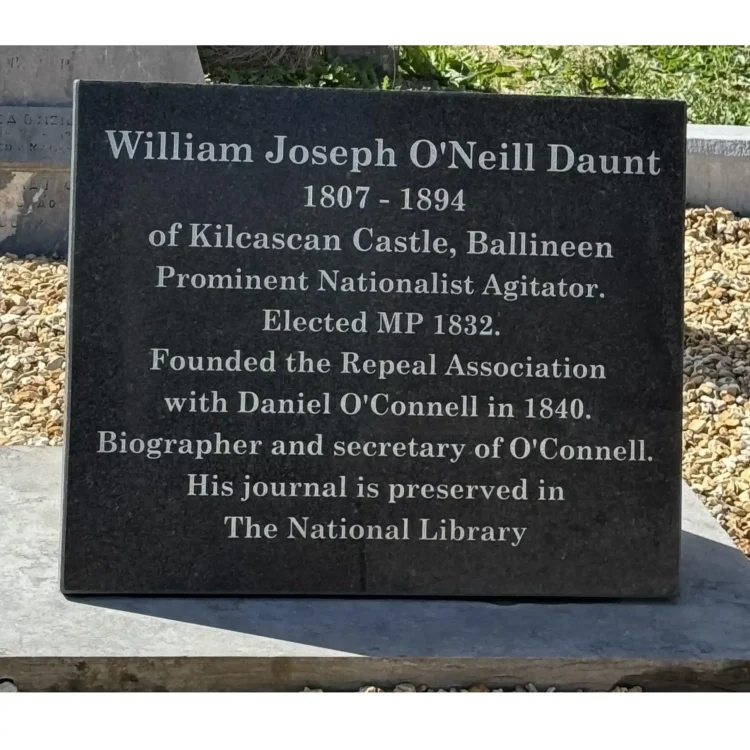
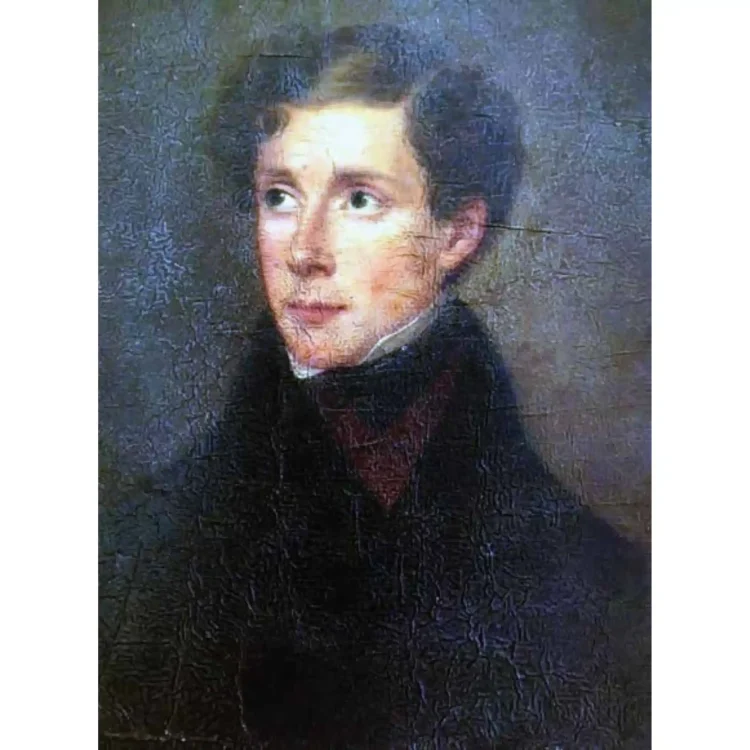
Not far from Doheny Family Plot in St. Patrick’s Church lies the grave of William Joseph O’Neill Daunt adjacent to the church founded by his friend Father Doheny. Until recently, the considerable contribution of William Joseph to politics and literature had been forgotten. Born in 1807 in Tullamore where his father was captain of the Louth Militia. He was reared at his father’s estate in Kilcascan, Ballineen a short distance from Dunmanway. The Dictionary of Irish Biography states he was influenced by the Conners of Connerville, especially Feargus. Feargus’s father Roger officially changed his name from Conner, with an e to O’Connor with an o. Feargus’s uncle, Arthur O’Connor, was a prominent figure in the United Irishmen. Arthur, a member of the Irish Parliament , was arrested in 1798 and banished to France. The future Emperor Napoleon supposedly appointed him General of an Irish division readying itself for an invasion of Ireland that never happened.
William Joseph’s father died in a duel, in 1826. He was shot by his cousin, Daniel Connor (or Conner) of Manch House. The cause – stemmed from a courtroom disagreement, where Joseph Daunt publicly insulted Daniel Connor—the local magistrate. This 1826 duel is often recorded as one of the last fatal duels fought in Ireland.
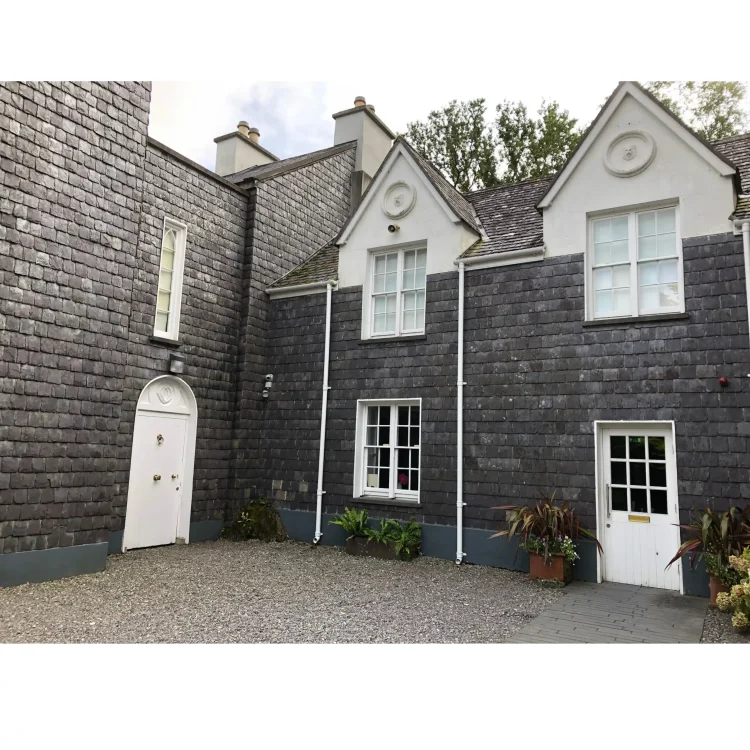
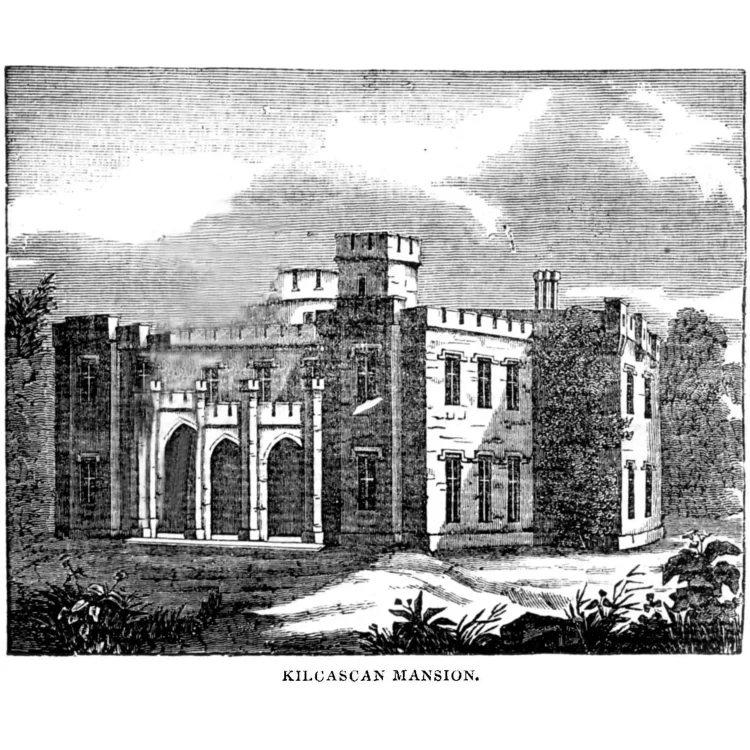
Following his father’s death, 19-year-old William Joseph O’Neill Daunt inherited the family estate, Kilcascan Castle, a gothic style castle built around 1819.
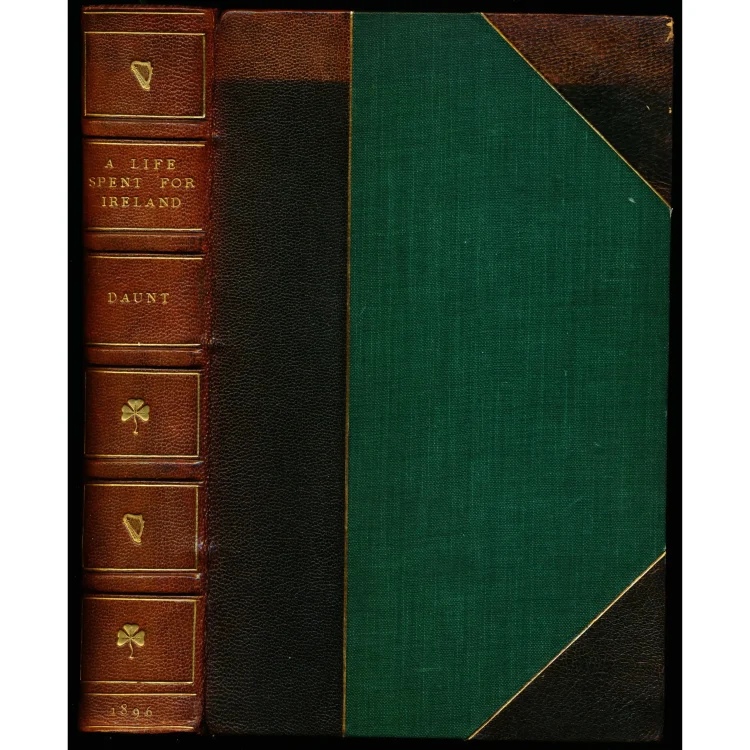
Though raised Protestant, he converted to Catholicism in the presence of Father Mathew. He entered politics becoming an MP for Mallow in 1832- supporting the repeal of the Act of Union. Daniel O’Connell appointed him to be his secretary when he was elected Lord Mayor of Dublin in 1841. Together with O’Connell he was one of the founders of the Repeal Association and was its director for Leinster. He remained a lifelong friend of O’Connell and his contribution is under recognised. He wrote –“ Personal Recollections of the Late Daniel O Connell” a year after O’Connell’s death. He was prominent in the Home Rule movement. From his home outside Dunmanway, he kept an eye on the political scene. His diary “ A Life Spent for Ireland” documents his life from 1842 to 1888. After his death, his daughter Alice edited his diary and his other novels. Interestingly -He did have a nom-de-plum, Denis Ignatius Moriarty – under this name he wrote five novels.
A simple plaque erected in 2025, commemorates one of O’Connell’s staunchest followers and Irish nationalist William Joseph O’Neill Daunt.
To download the full set of colouring sheets from the Dunmanway Stories on the Street Series, click here: