
Lewis’ topographical dictionary of Cork City and County, states that Dunmanway derived its name from the “castle of the yellow river” or the” Castle of the little plain” which related to the old MacCarthy castle long since demolished or “fort of the two yellow gables”.
Prior to the founding of Dunmanway town in the 17th century – the area was largely rural with medieval settlements dotted across the landscape in the vicinity of ecclesiastical settlements such as – at Fanlobbus and Kilbarry with fascinating histories often dating back to the 6th century.
In the 17th century, people in the rural areas lived in small hamlets. Many clan chieftainships still held lands under the system of Surrender and Regrant. The policy whereby the local clans surrendered their land to the King who in turn regranted the lands, often with English titles, in exchange for loyalty, obedience, and adopting English law over Irish customs.
The town owes its origins to Sir Richard Cox, Lord Chancellor of Ireland and First Baronet- Born in Bandon in 1650, Richard was the son of Katherine Bird of Clonakilty and Captain Richard Cox. He acquired from King William the third, letters patent with a grant to hold a market and fairs in 1693. Old sources recall his stately mansion. What is currently referred to as the Manor House in Dunmanway is most likely the third Cox house built on the same site of the second house. While the first house was initially built as a summer residence for Sir Richard, it is often described as being situated on a precipice overlooking Dunmanway Lake and is located between two streams that run down the hillside, surrounded by an oak forest. The first house most likely was a wooden Tudor-style residence situated somewhere in the vicinity of today’s old convent buildings.
Sir Richard needed his new town to be accessible for growth. Access then – to Dunmanway was through the northern route via the road known as the Spa Road. So named because of the healing spa and well waters in that area. In the early years the River Bandon would often be in flood, cutting off access for both horses and humans. Only a few times in the year would the river be shallow enough for locals and horses to pass. Sir Richard built the Long Bridge consisting of 6 arches, accessibility helped the town to grow.
Cox purchased his estate around Dunmanway in 1690 from William Arnoppe who was granted an estate of almost 3,000 acres at Dunmanway in 1666. Cox was knighted in 1692 and created the Cox Baronet in 1706. In 1674, he married Mary, daughter of John Bourne of Carbery, Co. Cork; they had at least twenty-one children, of whom five daughters and two sons survived into adulthood. He died in 1733 . An interesting fact is that his portrait is hanging in the Royal Hospital Kilmainham. The eldest son, also called Richard, predeceased Cox and the baronetcy passed to his grandson Sir Richard Cox who became second baronet.
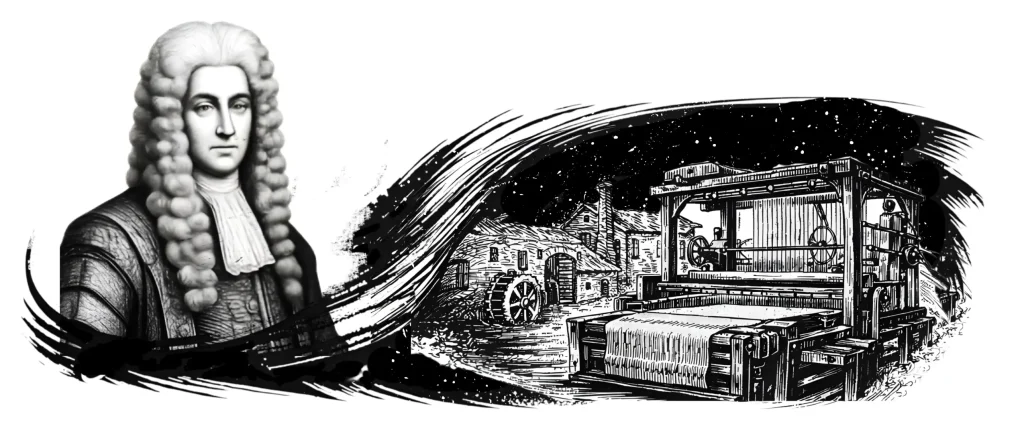
Richard Cox, the second Baronet, promoted the linen industry and established Dunmanway as a leading local market town. Early industrialisation of the town centred on the linen industry putting Dunmanway firmly on the 18th century textile map. Great emphasis was placed on the quality of the linen and on the local flax . Linen Workers were rewarded with prizes every year. The Winner received a title of Master of Manufacturers and was given a house rent free for a year. Cox founded a spinning school in 1746 and a family was brought from the north of Ireland to run it.
He established a May Day tradition when the spinning girls brought out their spinning wheels to the green and spun the flax. The most skilful spinners won a prize. The town’s population and the Linen industry flourished . Dunmanway’s Linen Fair became famous in the country. Cloth from all over the area was exhibited and sold here. Two bleaching greens, close to the town centre were in constant use, hence the East Green and the West Green names. The population increased dramatically by 1755.
The two years 1747 to 1749 witnessed a huge growth in the linen industry. In 1747 it was estimated that there were 87 flax wheels and 51 woollen wheels in operation – however by 1749 this had increased to 226 flax wheels and 28 woollen wheels plus those at the spinning school.
Recent research suggests some of the original weaver families originated in Scotland. They moved to Antrim and from there they were head hunted and brought to Dunmanway by Cox. Some of them resided in the Kilmichael area before finally settling in the town proper. By the late 1780s these families were living in Dunmanway.
Sir Richard’s death in 1766 was a major setback. He had insisted on the highest of standards and modern linen techniques. With his passing the old methods reemerged, standards slipped resulting in a poorer quality of cloth. Increased mechanisation revolutionised the textile industry however many in Dunmanway still used hand looms. By the early 1800s Dunmanway’s linen industry was in decline.
In 1837 , Dunmanway had 2,738 inhabitants. Subsequent generations of the Cox Family left their imprint on the town. Two sisters, Katherine and Martha being the last known descendants to reside in the Manor House. They are fondly remembered for their benevolence during the Famine years when they provided soup for the hungry. So much so that a special silver service tea-set was presented to the sisters by the local community before they left Dunmanway.
Martha and Katherine Cox were among the principal lessors in the parish of Fanlobbus, at the time of Griffith’s Valuation. In November 1858, they offered almost 7000 acres of the estate, for sale in the Encumbered Estates Court. The sale notice indicates the purchasers of the various lots. They included the Baldwin, Bryan, Becher, Hamilton and Shuldham estates. In October 1873, 1300, acres owned by Katherine Anne Cox, around the town were offered for sale. The old Cox Burial Vault is located at Saint Mary’s Church which was founded by Henry Cox in 1821.
Cox’s Hall is named in memory of the Cox Family. In recent years a number of Cox descendants have re-connected with Dunmanway and provided additional family information to the local historical association.
To download the full set of colouring sheets from the Dunmanway Stories on the Street Series, click here: