
St Mary’s Girls Senior School NS
Two girls from St Mary’s, standing near the plaque at the crossroads after school.
Katie: Hard to believe this is our last year as an all‑girls school. Next year we’ll be in the new mixed school with the boys from Scoil Phadraig.
Molly: I know. It feels strange… but kind of exciting too. Miss said it’s “the end of an era.”
Katie: Yeah. And look where we’re standing – the crossroads of Dunmanway.
Main Street, Wesley Place, Church Street and Sackville Street all meet here. She called it the “religious crossroads” of the town.
Molly: Because everything is around us. There’s St Patrick’s Hall, St Mary’s Church of Ireland, the old convent is behind St Patrick’s Hall, the boys’ school at Sackville Street, the Methodist church, now known as Atkins Hall is all nearby.
Katie: St Patrick’s Parochial Hall was built in the 1880s. People used to call it the Town Hall. It had dances, concerts, plays – all sorts of events were held there.
Molly: And right beside it are the old convent gates – where the nuns lived. The Daughters of Charity, isn’t that what they’re called?
Katie: They started in Paris in 1633. They came to Ireland to help the poor – teaching, looking after sick people, and helping families. In 1887 Canon Lane, the parish priest, asked them to come to Dunmanway to run the Catholic school.
Molly: At first they didn’t even have a convent. They rented Brookpark House up on Quarry Road and taught in a tiny, whitewashed school beside St Patrick’s Church – where the Nun’s Plot is now.
Katie: They were busy! They taught children by day, visited the workhouse, and even did night classes for grown‑ups. Sister Mary Blundell started a boarding school called St Vincent’s High School. Some of the first girls came all the way from Lanark in Scotland.
Molly: The convent here was copied from their convent in Lanark too. It was built on land called the “Turret” or “Forest,” from a solicitor, Francis Fitzmaurice. Miss said he lived in Carbery House and was caught up in the revolutionary history of 1922.
Katie: By 1889 the convent was built, and a new primary school on the sloping ground behind St Patrick’s Hall. Later, the De La Salle Brothers opened the boys’ school in the 1890s. That’s how Dunmanway became known for its schools.
Molly: And the nuns were great for music – choirs, little orchestras, piano lessons. And don’t forget the Home Economics! People still talk about their amazing Christmas cakes with fancy icing.
Katie: So, when our schools join together in 2026, it’s like another crossroads moment. Things are changing again,
Molly: But the history is still here – the halls, the churches, the convent – and now our new school will be part of the story too.
Katie: Exactly. Different school – a new era but the same crossroads – steeped in history.
St Mary’s Girls Senior School NS
Three friends from school are standing near St Patrick’s Hall after a history walk.
Una: That tour was kind of scary. Our town had a lot of fighting back then in the 1920s.
Aoife: It did, but it’s important we know about it. See over there, beside St Patrick’s Hall? That used to be the RIC barracks – the old police station.
Niamh: RIC? What ??
Aoife: Royal – Irish – Constabulary. They were the police force in Ireland before the Gardaí. Their barracks here was built so they could see all four streets – Main Street, Sackville Street, Church Street and Wesley Place – like a lookout crossroads.
Una: Miss said that people were told to stay away from the RIC, and later new men came from Britain to act like the police they were called the Black and Tans because of the colours of their uniforms.
Niamh: They were mostly based in the Workhouse, weren’t they?
Aoife: Yeah. But they were very cruel and even sent the patients away or rather threw them out whether they were sick or not. People were afraid of them.
Families had to cover their windows at night so no light showed through, or the Tans might think there was a secret meeting and raid the house.
Una: And then that awful event in 1920…
Niamh: When Canon Magner, the priest, and a young man, Tadhg Crowley, were shot by an Auxiliary officer on the road outside town. They weren’t armed at all. So sad!
Aoife: There’s a monument at Canon Magner’s grave in St Patrick’s churchyard, and another at the place where they were shot. People still visit there.
Una: And the Dunmanway massacre? What’s that about ?
Aoife: In April 1922, during a shaky peace, fourteen Protestant men were killed around here and in the Bandon Valley. No one ever took responsibility. Historians still argue over why it happened, but everyone agrees it was a terrible time.
Niamh: Three of them were from – right here in town – Mr Fitzmaurice at Carbery House, and Mr Gray and Mr Buttimer on Sackville Street. They all had shops and were well known locally.
Una: It’s really sad thinking neighbours could be killed like that.
Aoife: It is. That’s why we remember it carefully, so we don’t repeat it.
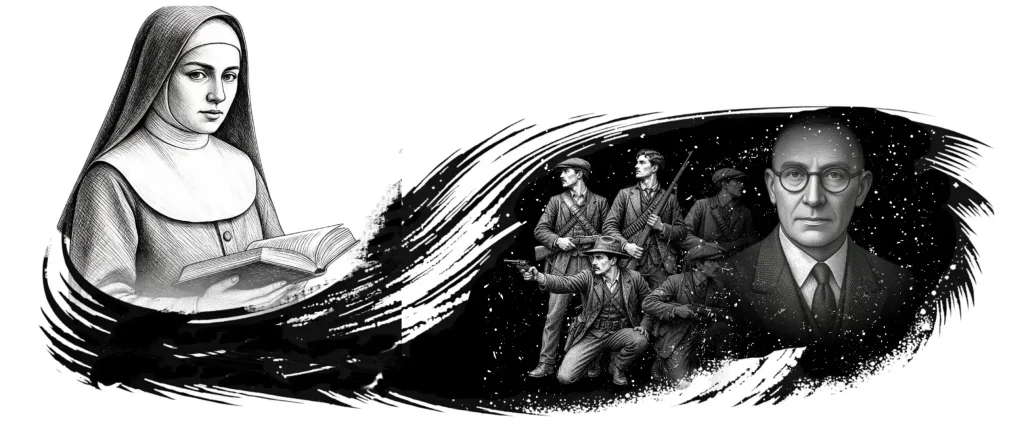
Niamh: But the story doesn’t end there. After all that, people started to rebuild. Do you remember T. J. Murphy from the classroom display?
Una: The man with the glasses in the photo?
Aoife: Yes. He moved to Dunmanway and became a TD for Cork West in 1923. Later he was was Minister for Local Government. He helped rebuild the burned Workhouse into Dunmanway Cottage Hospital, with wards and a maternity unit, and pushed for new council houses so families had better homes, not just here in town but all over Ireland.
Niamh: That’s why there’s a T. J. Murphy Place near here – named after him.
Una: So – the town went from dark days to new houses and a hospital.
Aoife: Exactly. Our history has both sad and hopeful parts. And we’re the ones telling the next chapter.
To download the full set of colouring sheets from the Dunmanway Stories on the Street Series, click here: