
Standing at this plaque, you are literally at a crossroads in Dunmanway – where Main Street, Wesley Place, Church Street and Sackville Street all meet, and where much of the town’s religious, social and educational history comes together. This junction once had strategic importance for defending the town, as each road is a key route into Dunmanway.
On one side stands Saint Patrick’s Parochial Hall, built around the 1880s and long known locally as the Town Hall. For over a century it has been a lively community space, hosting everything from socials and concerts to plays and public meetings.
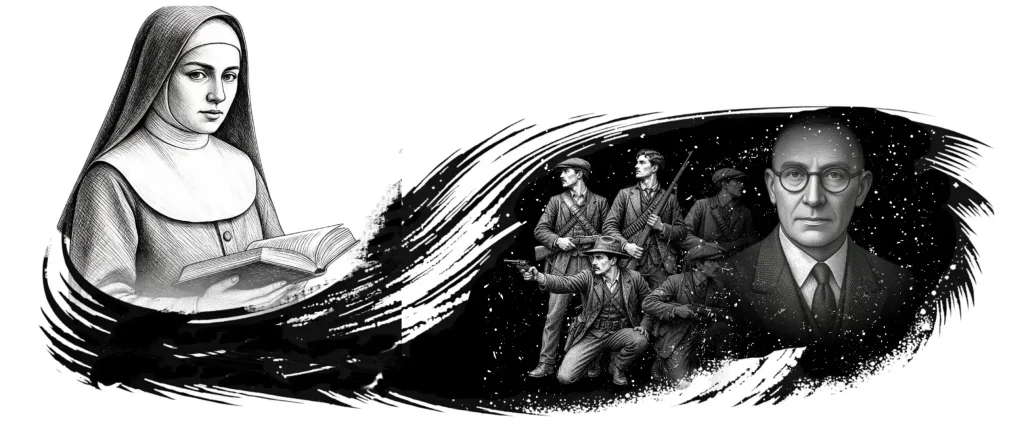
Beside it, the old convent gates mark the presence of the Daughters of Charity of Saint Vincent de Paul, a religious order founded in Paris in 1633 by St Vincent de Paul and St Louise de Marillac. The sisters came to Ireland in 1855 to serve the poor through education, health care and social outreach, and in 1887 they were invited to Dunmanway by the parish priest, Canon Lane, to take charge of the local Catholic school.
At first, the sisters rented Brookpark House on the Quarry Road and taught in a simple, whitewashed one‑room school beside St Patrick’s Church, on the site now known as the Nun’s Plot. True to their Vincentian tradition, they taught during the day, visited the nearby workhouse, and even ran night classes for adults. One of the founding sisters, Sr Mary Blundell, opened a boarding school, St Vincent’s High School, whose first pupils came from Lanark in Scotland. The convent itself was modelled on one of their community houses in Lanark and built on land leased from local solicitor Francis Fitzmaurice. The area was known as the “Turret “ section of land known as the “Forest”. Fitzmaurice was later to become part of Dunmanway’s revolutionary past. He lived in the nearby mansion- Carbery House.
By 1889 the community had built a permanent home in St Mary’s Convent, with a new primary school built on the lower, sloping ground behind St Patrick’s Hall. The sisters’ school, along with the De La Salle boys’ school which opened in the 1890s, helped make Dunmanway a small regional centre of Catholic education. The sisters had an excellent reputation for teaching music to children and they formed their own choir with orchestral groups. The Home Economics and Boarding Facility was regarded throughout Ireland.
A short distance away you can see the former Methodist Church, built in 1836, now Atkins Hall, St Mary’s Church of Ireland built in 1821, and St Patrick’s Catholic Church – a cluster of churches and schools that makes this corner of Dunmanway a true “religious crossroads” .
During Ireland’s revolutionary period, Dunmanway – like much of West Cork – saw intense violence, including attacks on the Royal Irish Constabulary (RIC) and a controversial series of killings in 1922.
The Irish Constabulary was established in 1836. Queen Victoria granted this force the right to use the prefix ‘Royal’. In January 1919, the RIC had 1,300 barracks across the country. One of which was strategically positioned in Dunmanway.
It was situated beside St Patrick’s Hall- at the crossroads of Main Street, Sackville Street, Church Street and Wesley Place. Its position allowed for a full view of all the roads leading into and out of Dunmanway. Typical of Victorian architecture at the time, it was austere with a small walled garden entrance to the front. In April 1919 – the First Dáil called on people to socially ostracise the RIC constables. This led to hundreds of resignations. By 1920, it was necessary to reinforce the RIC by personnel recruited in Britain who became known as the ‘Black and Tans’ and also by the Auxiliary Division of the RIC. In August 1922 , the RIC was disbanded. It was replaced by the Garda Síochána in the Irish Free State. The current Garda Station is located across from the old RIC barracks.
Dunmanway was a main focus of conflict and tensions escalated sharply on 15 December 1920, when Auxiliary officer , Cadet Vernon Hart, shot dead the local parish priest, Canon Thomas Magner and 24‑year‑old Tadhg Crowley about a mile outside the town. Both were unarmed and not believed to be involved in politics. Their deaths caused outrage locally and nationally. It is believed that their deaths were an act of reprisal for an ambush earlier in Cork City.
A monument dedicated to Canon Magner’s at his grave can be found in St Patrick’s Church yard while the location of the shooting is marked by a further monument a short distance from St. Joseph’s graveyard.
The notorious, Black and Tans were mainly stationed at the Workhouse, having discharged all the patients. Many locals were intimidated by the Black and Tans. They often opened fire sporadically on anything or any person that aroused suspicion. Dunmanway people had to keep their windows darkened with cloth and if any light were visible – it was assumed that a meeting was taking place and the house raided by the Tans.
Violence flared again in April 1922, shortly after the Anglo‑Irish Treaty and during a fragile truce. Between 26 and 28 April, fourteen Protestant men were killed in and around Dunmanway and the wider Bandon Valley in what has become known as the Dunmanway massacre. The shootings were a reprisal for the killing of IRA officer Michael O’Neill at Ballygroman. The motives and chain of command behind the shootings are debated by historians.
The first victims in the town itself were three prominent Protestant civilians attacked in their homes in the early hours of 27 April 1922. Solicitor and land agent Francis Fitzmaurice who was shot at the front door of Carbery House. His law practice was in the adjoining annex.
Chemist, David Gray and retired draper, James Buttimer were shot at Sackville Street. Both Draper and Gray had shop premises in the Square and were neighbours. An inquest concluded that all three died from close‑range gunshot wounds. Over the next two days further men were shot in rural areas around Dunmanway, Ballineen and Murragh.
No individual claimed responsibility and historians continue to dispute whether the victims were targeted as alleged informers or were killed in a sectarian attack. Today, these events are remembered as some of the most traumatic episodes in the town’s twentieth‑century history, highlighting how deeply the national struggle and its aftermath scarred this West Cork community.
As peace and order was restored in the late 1920s. Timothy Joseph Murphy- known as “T. J.” emerged on the Dunmanway political scene. He was a Labour Party TD for Cork West and one of Dunmanway’s most important public representatives.
Born in Clondrohid, he moved to Dunmanway around 1920. and was elected to the Dáil He was elected to the Dáil in 1923 and represented the Cork West until his sudden death in 1949. He also served on Cork County Council. He also was responsible for the rebuilding of the burned Dunmanway Workhouse and it’s renaming as Dunmanway Cottage Hospital offering a large array of medical services with surgical and maternity units. He was re-elected at the next nine general elections, until his death
He was appointed, Minister for Local Government in the first inter‑party government in 1948. He pushed for more local authority house‑building projects to tackle post‑war shortages.
He encouraged the use of direct labour rather than private contract, – an approach that influenced later public‑housing schemes and is part of his policy legacy.
At community level his advocacy for labour rights, public health and housing, helped improve living conditions for working families across West Cork. Today his contribution is remembered in Dunmanway in the naming of “T. J. Murphy Place,” a housing development a short distance from here. His name is also on a few other housing developments across Munster. Following his death his son took his seat in the Dáil and they continued to live at Sackville Street. The family live locally.
To download the full set of colouring sheets from the Dunmanway Stories on the Street Series, click here: