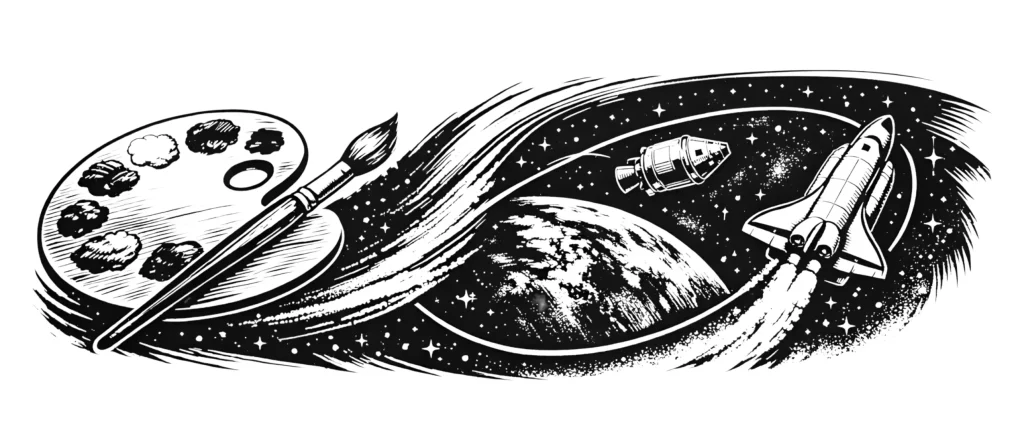

Eileen Marie Collins was born in New York, USA in November 1956. She is famous as the First Woman to pilot a Space Shuttle and later become the first female Commander of a U.S. Space Shuttle. A trailblazing astronaut – she has ancestral origins to Dunmanway.
Her paternal ancestors , the Collins’s left Ireland in the mid-1800s and settled in Pennsylvania. Her ancestors came from the wider Dunmanway hinterland. Her great, great grandfather Jeremiah Collins, was from the Lisbealad / Drinagh area. Jeremiah and his wife -who was probably from Kinneigh, emigrated to the USA.
Several years ago, Eileen visited Cork and was met in the City by members of Dunmanway Historical Society. Eileen broke the glass ceiling in NASA for female Pilots. According to the National Women’s Hall of Fame her family struggled to make ends meet and Eileen paid for her own flying lessons initially. After studying at Syracuse and Stanford Universities she became a math instructor at the Air Force Academy and a test pilot at Edwards Air Force Base. Selected by NASA in 1990 she became an astronaut and in 1995 became the first woman to pilot a space shuttle and was afterwards honoured by President Clinton in the White House. In 1999 she was made commander of the Columbia shuttle for Mission STS-93 and according to NASA the mission made space shuttle history. It was the first mission to be commanded by a woman, Eileen Collins.
It was a five-day mission, where experiments included capturing ultraviolet imagery of Earth, the Moon, Mercury, Venus and Jupiter.
Under her command, astronauts monitored several plant growth experiments and collected data.
As a trailblazing woman she stated: “I want to do well because I know I’m representing other women, other pilots, ”. She is highly decorated and some of her accolades include – Distinguished Flying Cross, French Legion of Honor, NASA Outstanding Leadership Medal and National Space Trophy among others. Her ancestors left- an Ireland ravaged by starvation and disease. Little did they think their great, great, granddaughter would fly high into the cosmos.
Imagine a grandson of a Dunmanway man, piloted to the moon!
Famed Apollo 11 mission astronaut, Michael Collins was born in Rome in 1930 to American parents of Irish and British descent. He was proud of his Irish roots. He was famous as the pilot of the first moon landing in July 1969. His Irish ancestry traces back to his grandfather, Jeremiah Bernard Collins, who emigrated from Dunmanway, in the 1860s. Jeremiah came from the Droumdrastill area. He left Dunmanway as a young boy in the early 1860s to join family members in Ohio. Jeremiah later served in the U.S. Civil War. According to an article in Irish America, family lore says Jeremiah served as a drummer boy in the American Civil War and later helped drive horses into Texas to replace cavalry mounts lost in the war. After the war he moved to New Orleans where he worked for a grocer named James Lawton. He then married Lawton’s daughter Kate. Jeremiah and Kate set up a dry‑goods store with a pub in the back in Algiers in New Orleans. They had 11 children, all involved in the business.
Their son, James Lawton Collins became a career U.S. Army Major General who served in both the First and Second World Wars. In the First World War, Collins served under General Pershing with the American Expeditionary Forces in France. During the Second World War he had been promoted to Major General and became Director of Army Administration helping manage logistics for the rapidly expanding U.S. Army. While he was stationed in Rome in 1930 his son Michael was born.
Features on astronauts with Irish ancestry repeatedly list Collins and note that his Irish roots can be traced specifically to Dunmanway. In his lifetime, Collins expressed pride in his Irish heritage, particularly his ties to County Cork.
Thomas Hovenden was born in Dunmanway on 28 December 1840. He was a famine orphan who became one of America’s most admired realist painters, remembered for his empathy and social conscience. An obituary in a Cleveland newspaper called him a “hero artist,” noting that anyone who had stood before his painting “Breaking Home Ties” at the World’s Fair would not be surprised he died trying to save a child, having always been “one of the obscure heroes on the battlefield of life” .
He was the son of Robert Hovenden, Dunmanway’s gaolkeeper, and Ellen Bryan, daughter of a Methodist minister. He grew up in the town Bridewell on Main Street with his siblings John and Elizabeth. The building still resembles a Victorian gaol, with its carved stone façade. During the famine years of 1846–47, both his parents died from famine illnesses. The children were placed in an orphanage in Cork City .
In Cork, staff noticed Thomas’s artistic talent. He was apprenticed to a carver and gilder named Tolerton, who later helped him gain entry to the Cork School of Design around 1860, possibly on the strength of a detailed drawing of the Venus de Milo. Some of his early watercolours and this work were later listed in exhibition catalogues, including one at the Smithsonian. At that time, he was residing in New York. Hovenden became known for meticulous shading and layered detail, hiding figures and objects in shadow so that the more you look, the more you see.
He emigrated to the United States from Queenstown – now Cobh – on a ship called the City of Baltimore in August 1863 and resided mainly in Philadelphia, Baltimore and New York, with artistic – study periods in Paris. In the mid‑1870s he trained under Alexandre Cabanel at the École des Beaux‑Arts. He lived near the Louvre. In 1875 he met fellow artist Helen Corson at an artists’ community in, Brittany; they married in 1881, had a son and a daughter. Thomas became a naturalised citizen in 1887, one year after his appointment as Professor of Painting at the Pennsylvania Academy of the Fine Arts in 1886.
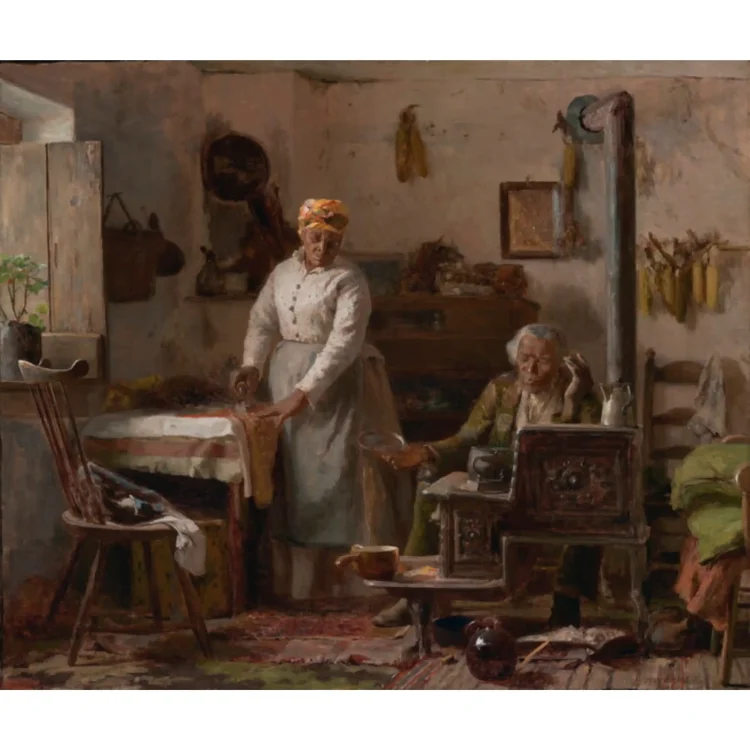
Hovenden produced over 100 works focusing on domestic life, and African American subjects, reflecting his abolitionist views and famine-shaped compassion. In paintings such as “Chloe and Sam,” he depicted coloured domestic life with unusual tenderness and dignity for the period. His “The Last Moments of John Brown” painted in 1884, in the Metropolitan Museum of Art in New York portrays Brown on his way to his execution. It was painted for one of Hovenden’s patrons – two decades after Brown’s death. “Breaking Home Ties” was painted in 1890. It depicts a young man leaving his family farm, it was voted the most popular painting at the 1893 World’s Columbian Exposition in Chicago.
Hovenden’s life ended tragically in August 1895. He and a ten‑year‑old girl were killed by a train near his home. Newspaper stories portrayed him as dying while saving her, the coroner ruled it an accident. Although his reputation dimmed in the early twentieth century, the Civil Rights era revived interest in his work, especially his sympathetic portrayals of African Americans. Today his paintings are again exhibited and studied across the United States.
To download the full set of colouring sheets from the Dunmanway Stories on the Street Series, click here: