
Ballincarriga National School
A Chat Between Sisters.
Mary:
Ellen, my back’s sore from that plank again. Doesn’t matter how I spread the straw, it still pokes through.
Ellen:
Mine too. I thought straw was for beasts, not girls. But at least it’s dry tonight. Remember when it was damp last week? I near froze before dawn. Did you hear that if this overcrowding continues , three of us will have to share our raised-up planks of wood as a bed?
Mary:
Yes , they say the workhouse can hold 400 paupers but now it seems it is close to 700 inmates . They are many gathering outside the gate waiting to be admitted and all for a bowl of soup that’s more water than anything else. They call it dinner, but I call it a cruel joke. Still if it keeps us alive. Can you hear the cries for help outside on the road ?
Ellen:
Still, there’s work to be done , so we’ve little time to dwell. Spinning all morning, dressmaking in the afternoon—my fingers ache by the time the Matron rings the bell.
Mary:
That department overseer watches us like a hawk in that room. Says every crooked stitch means a little less ration.
Ellen:
And after our stitching, straight to the schoolroom for lessons. Reading, writing and counting- they say it will help to prepare us for something better in the future. I wonder what “better” they mean.
Mary:
At least in the school we’re warm from the fire. Sundays aren’t so bad either, when we go to the chapel room. All the different faiths taking turns, so no fighting. Still, it’s strange hearing prayers echo from the same whitewashed walls where people sob at night. At the end of the day we are all the same poor paupers and some of us are orphans.
Ellen:
Master Burke says segregation -keeps order. Same as the uniform—we all look alike now. Gray, coarse cloth, itchy and scratchy especially at the neck. Makes me forget what my own pauper dress looked like.
Mary:
Heaven help is if we step out of line. You heard about the man last week?
Ellen:
The one sent to the black hole ? Yes,- solitary confinement, just for smoking a bit of tobacco. The Master said it was for “Moral Correction.” Poor soul.
Mary:
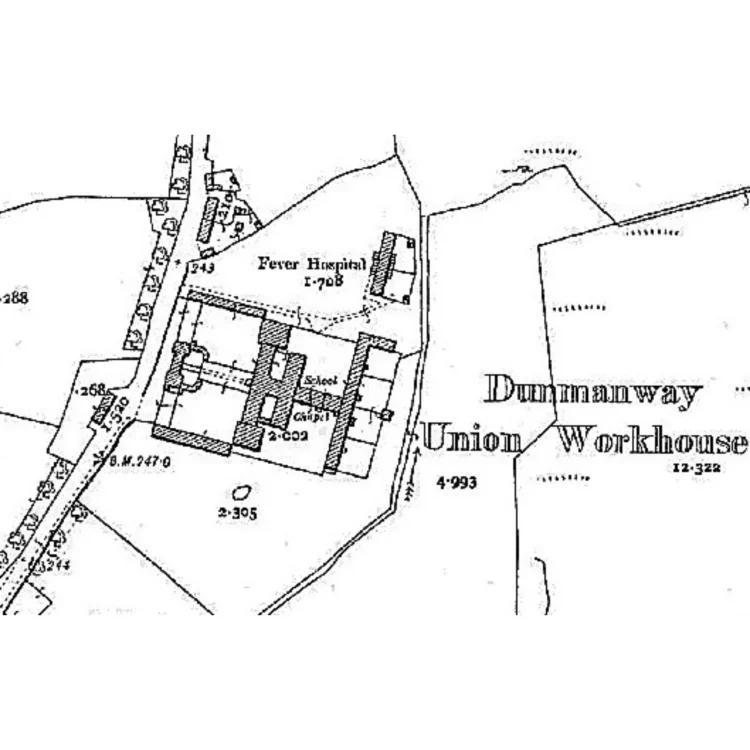
It frightens me, Ellen, that six-foot square room under the arch way at the rear, half exposed to the weather. You see what happens when they say you’ve broken the rules. The walls swallow you whole. Oh Ellen – if the walls could talk and all the stories of starvation they would tell.
Ellen:
Best we keep our heads down then, Mary. Do the work and pray for the day we’re free of this institution.
Mary:
We will have to hope the soup’s a little thicker tomorrow and has some more meat in it.
Ballincarriga National School
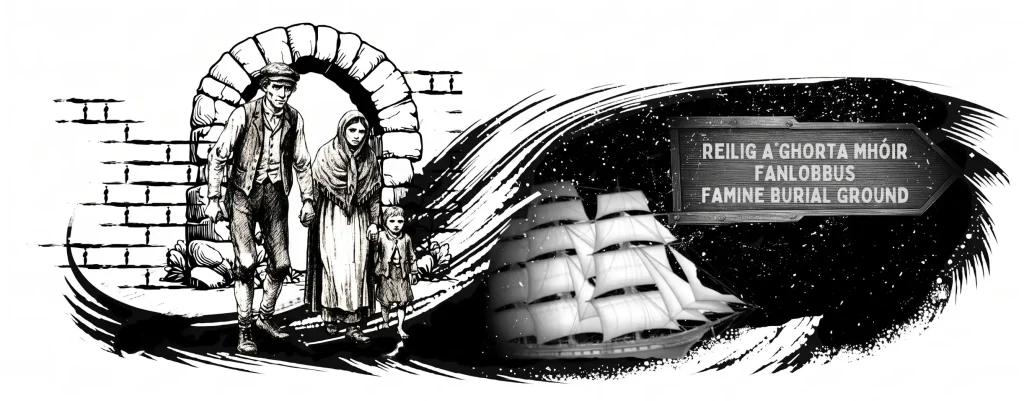
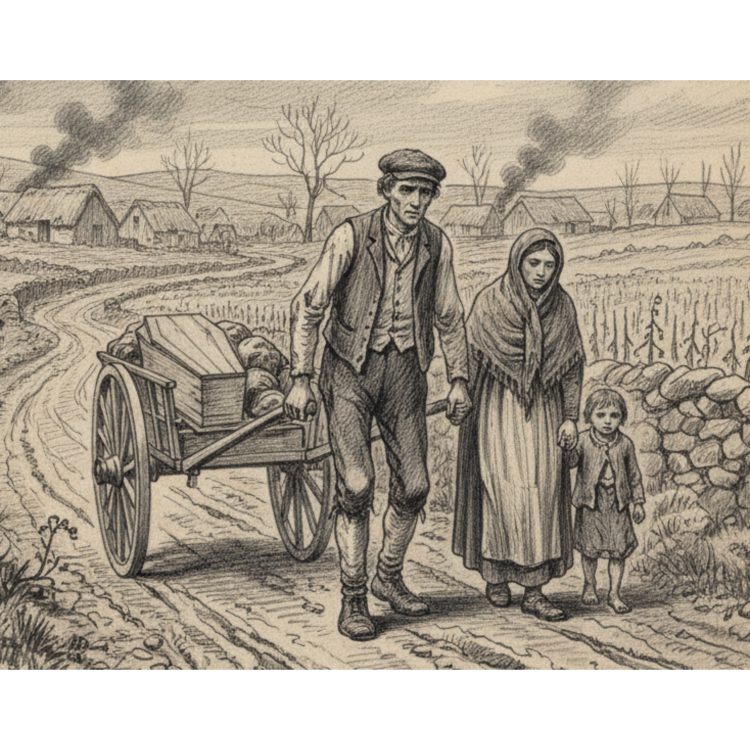
Patrick: Come along now, Seamus. Keep close. The Master said to show you the lay of the place before you help me take the bodies of the poor paupers for burial in Fanlobbus.
Seamus: I’ve never been inside one of these workhouses before.
Patrick: The other lad that helped me died of the famine fever. So, now it’s your turn to help me as you’ve turned 16. The payment we get from the Guardians of the Workhouse will help us to survive this year, 1847 seems to be looking like it is the worst of these hungry years. Keep your eyes open. There’s rules for everything in this place, the poor inmates are told—when to rise, when to eat, when to speak. Break one, and you’ll find yourself in trouble before you know it.
Seamus:
Yes father, I suppose there are rules for us grave diggers also, I will remember to keep my head down and not look idle.
Patrick: This over here is the yard for rock breaking. Men spend hours each day smashing stone for roadwork. Hard labour. Next to it, at the rear there is a small door in the back wall, that’s where we will take the famine victims to their final resting place. There is a narrow dirt track through the countryside to the back of Fanlobbus Graveyard about a mile and a half away.
Seamus:
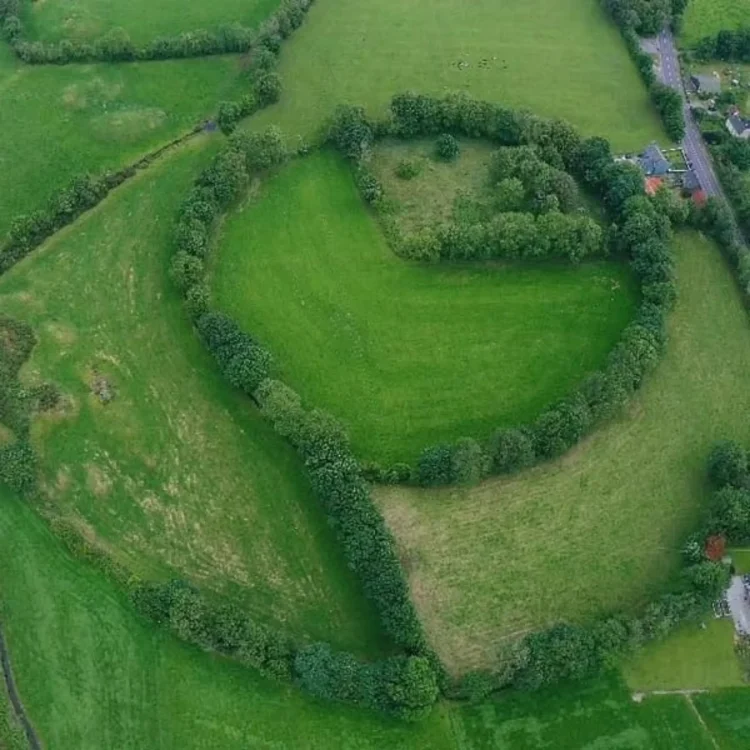
I didn’t know that there was a dirt track to Fanlobbus from this place. I only remember the new road being built recently under the Board of Works, it passes alongside the old ringfort with the entrance being a set of steps up and over the ditch.
Patrick: Yes, the mass burial pits are to the rear – in the hope that disease can be contained there, we must remember to spread lime in the grave pits. In 1845 we were able to lay the paupers side by side in graves but not any more. These days in 1847 we are burying them in multiples.
Seamus :
Is that the Fever Hospital over there, it’s made of wood.
Patrick :
Yes. Sick folk are kept apart to stop it spreading. Pray you don’t end up there; few that enter ever leave.
Seamus: I can smell the carbolic soap from here.
Patrick:
Sanitation’s the word they use now.
Seamus:
How old is the graveyard at Fanlobbus?
Patrick:
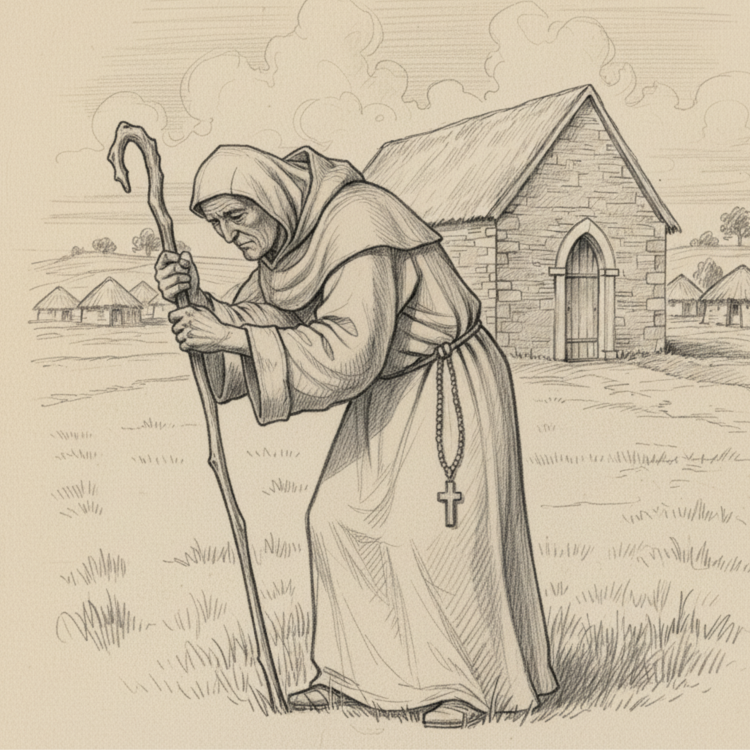
They say it dates back to the 6th century the century after St Patrick came to Ireland. But some say it goes back to an earlier time and there may have been a bronze age settlement there are it is made up of two circles, a type of double ring fort.
A saint called Saint Goban Corr is supposed to have set up his small monastery there. The word Corr means stooped in Irish probably from bending down to get into those small cells where they slept. I imagine years ago there was a community there of monks and ordinary people. It was there before the founding of Dunmanway town by Richard Cox in the 17th century.
Seamus:
Is St Goban’s church still there ?
Patrick:
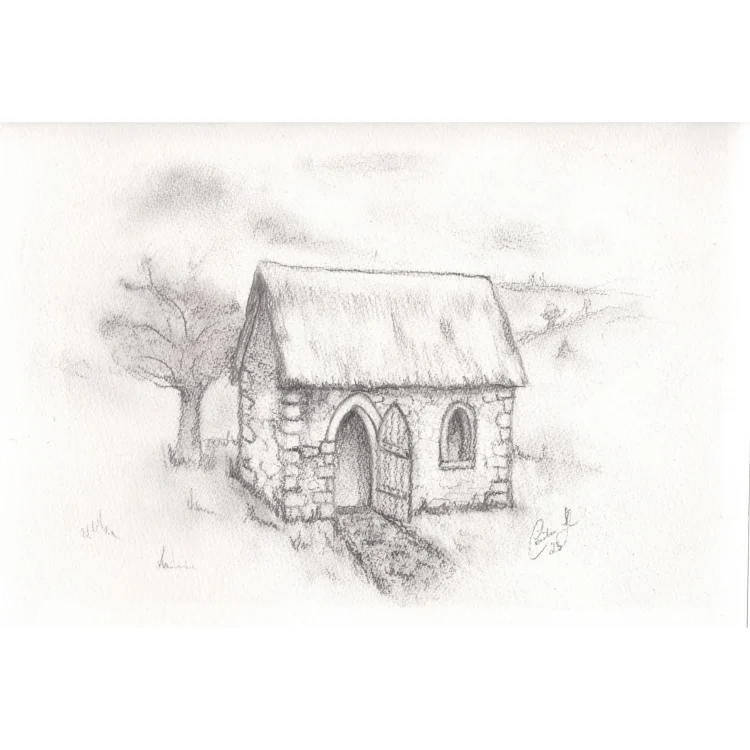
Only the ruins of a later 9th or 10th century church survive, the roof is caving in and some burials are taking place inside the ruins now. There is an old story that some of the old folks believe that one of the Randal Og Chieftains of Ballinacarriga Castle is buried there….no one knows for sure though.
Seamus:
I suppose we better get some ration for Peggy the horse before we collect the bodies for burial. Is there any superstition attached to the ring fort father?
Patrick :
The dead won’t harm us and we are trying to be as dignified as possible during these terrible times. By the way that’s the Board of Guardians’ Meeting Room over there and also the master and matrons’ offices . Be sure they don’t see you look idle.
Seamus:
Let’s go to Fanlobbus so while there is still daylight.
Ballincarriga National School
Narrator:
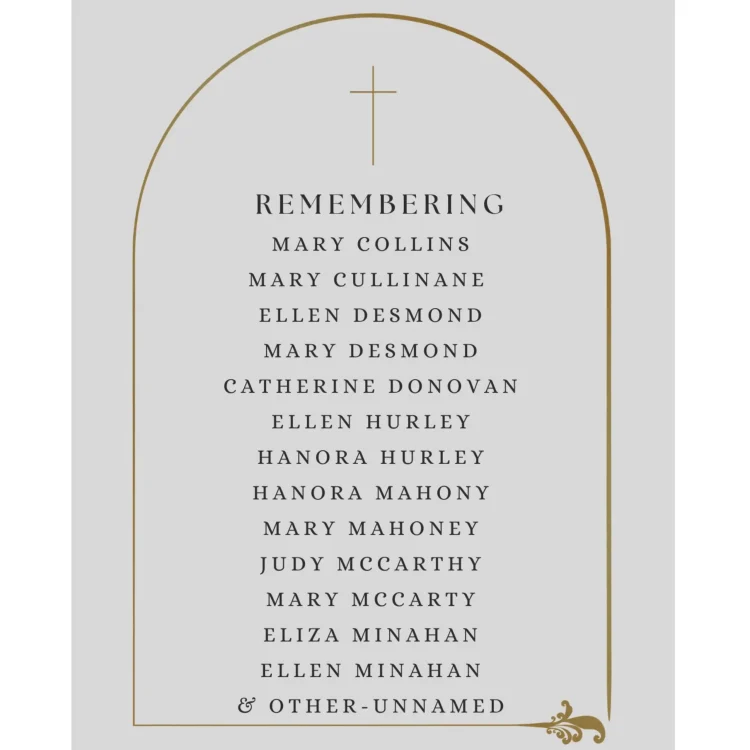
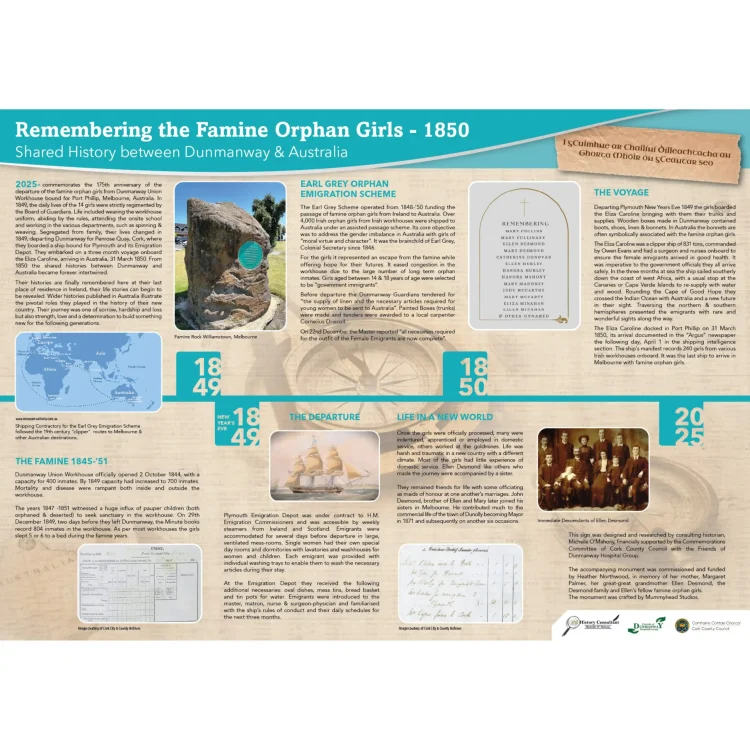
It is early December 1849. Fourteen orphan girls from Dunmanway Workhouse are chosen for the Earl Grey Assisted Passage Scheme. They are to sail for Port Phillip—now Melbourne—a world away from famine-stricken Ireland. Inside the workhouse sewing room, sisters, Mary and Ellen are stitching linen under flickering candle light.
Ellen:
Mary, is it true then? We’re really going—clear across the seas to Australia, the new world.
Mary:
Yes, Ellen. Chairman Conner read the names himself. Fourteen of us famine orphans, they call us “government immigrants.”
Ellen:
Immigrants! I’ve never stepped outside Ardcahan or Dunmanway come to think about it. How can we dream of Australia?
Mary:
Maybe it’s our chance, Ellen—no more workhouse soup, no stone floors , no more overcrowding, no more typhus and cholera- hopefully.
Narrator: the Chairman and the Matron arrive carrying a ledger
Daniel Conner:
Girls, the Guardians received word from the Poor Law Commissioners that Dunmanway Workhouse is to avail of funding from the Earl Grey Scheme. Each of the fourteen of you selected will be given a painted trunk with some boots, linen, a bonnet, new items of clothing which were ordered at Mrs. Dans together with your few belongings. Everything must be ready by December twenty-second.
Narrator:
Cornelius Driscoll enters, carrying a half painted -finished wooden trunk.
Cornelius Driscoll:
You’ll find these boxes strong and true, made from Dunmanway oak. They’ll hold what little you have—and all you’ll ever need, take a part of Dunmanway with you to the new world, I hear that you are landing at Port Philip. Arrivals there are sometimes mentioned in the Cork newspapers a few months later.
Ellen:
Thank you, sir.
Cornelius Driscoll:
Keep it safe, lass. It’ll carry your name across the world.
Matron Burke:
And remember—the rules on ship are like those here: neatness, quiet, respect for the Master and Surgeon. You’ll receive further utensils at Plymouth Emigration department and will be familiarised with the ships rules, and share the onboard duties.
Mary:
So, it is still a workhouse…… only floating.
Matron Burke:
Perhaps. Yet one with a horizon and hope for the future and the prospect of seeing far flung lands , I have heard stories of exotic birds and sea creatures along the route, amazing sights will await you as you Round the Cape of Good Hope and cross the Indian Ocean.
Narrator:
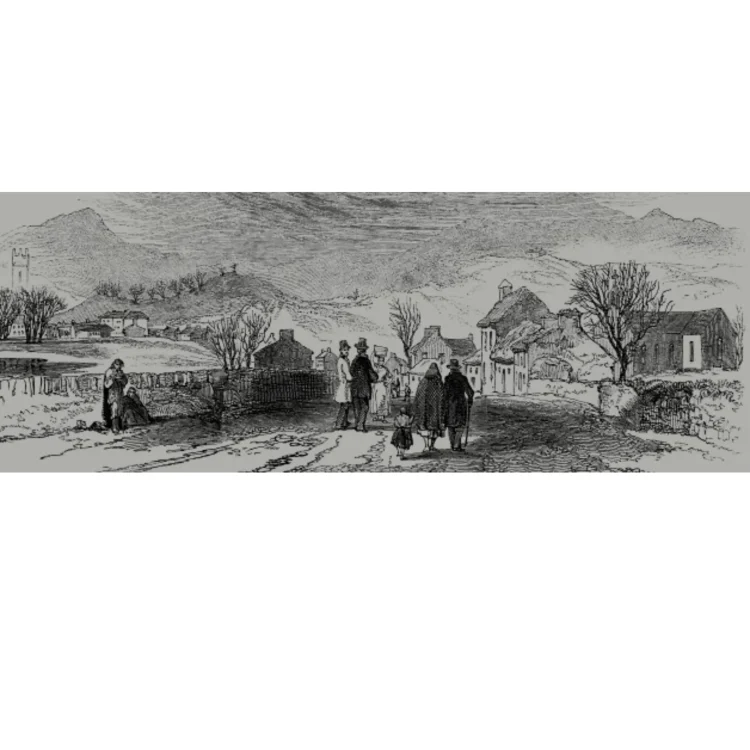
On December twenty-third, just before Christmas, the girls left Dunmanway by horse and cart—trunks piled high—bound for Penrose Quay, Cork. From there, a steamer carried them to the Plymouth Emigration Depot. A ship’s bell rings. Owen Evans, the captain, calls from the deck.
Captain Evans:
Welcome aboard the Eliza Caroline! All 831 tons, bound for Port Phillip! Anchor lifts at midnight—New Year’s Eve 1849 , ladies.
Ellen:
This ship is a Clipper Ship and supposedly she has been to Australia and back many times already. Look, Mary—see the sea! Endless blue, bigger than anything in Ireland.
Mary: Three months at sea, we will be in Australia for Easter 1850, we better follow orders, and never forget we carry the hopes of those back in Dunmanway with us.
Narrator :
Their journey begins with the girls clutching their hats and bonnets as the wind whips us at sea.
Ellen:
Do you think we’ll see home again, Mary?
Mary:
Maybe not, but we’ll make one there. That’s hope enough
Narrator:
On March 31, 1850, the Eliza Caroline reached Port Phillip. Two hundred and forty Irish orphan girls walked ashore—including the fourteen from Dunmanway. The Eliza Caroline was the last ship to bring famine orphans to the Melbourne area.
Ellen:
Look at the quayside Mary, there are lots of other women there, they must be the ladies who are to find us domestic work in the big houses here or else they are the ladies who are looking for servants and cooks to work at the goldmines.
Mary:
We came with nothing but hope. Let’s hope that life won’t split us up in this vast continent.
Narrator:
In 2025, a monument was unveiled in Dunmanway to honour those fourteen brave girls—Mary and Ellen Desmond among them. Their journey—born of hunger—became a story of endurance, courage, and unbroken spirit.
To download the full set of colouring sheets from the Dunmanway Stories on the Street Series, click here: